Build Your Own World
Build Your Own World Using Narrative Direction
Characters move through the social systems within your story whether they want to or not. Narrative direction opposes and propels characters through the tides of complex systems. Every system, whether legal, economic, technological, or magical, has tension points where something is scarce, contested, or fragile.
Through these tension points, characters can be pushed into action naturally. Through the pressure of this tension, characters are moved out of their comfort zone.
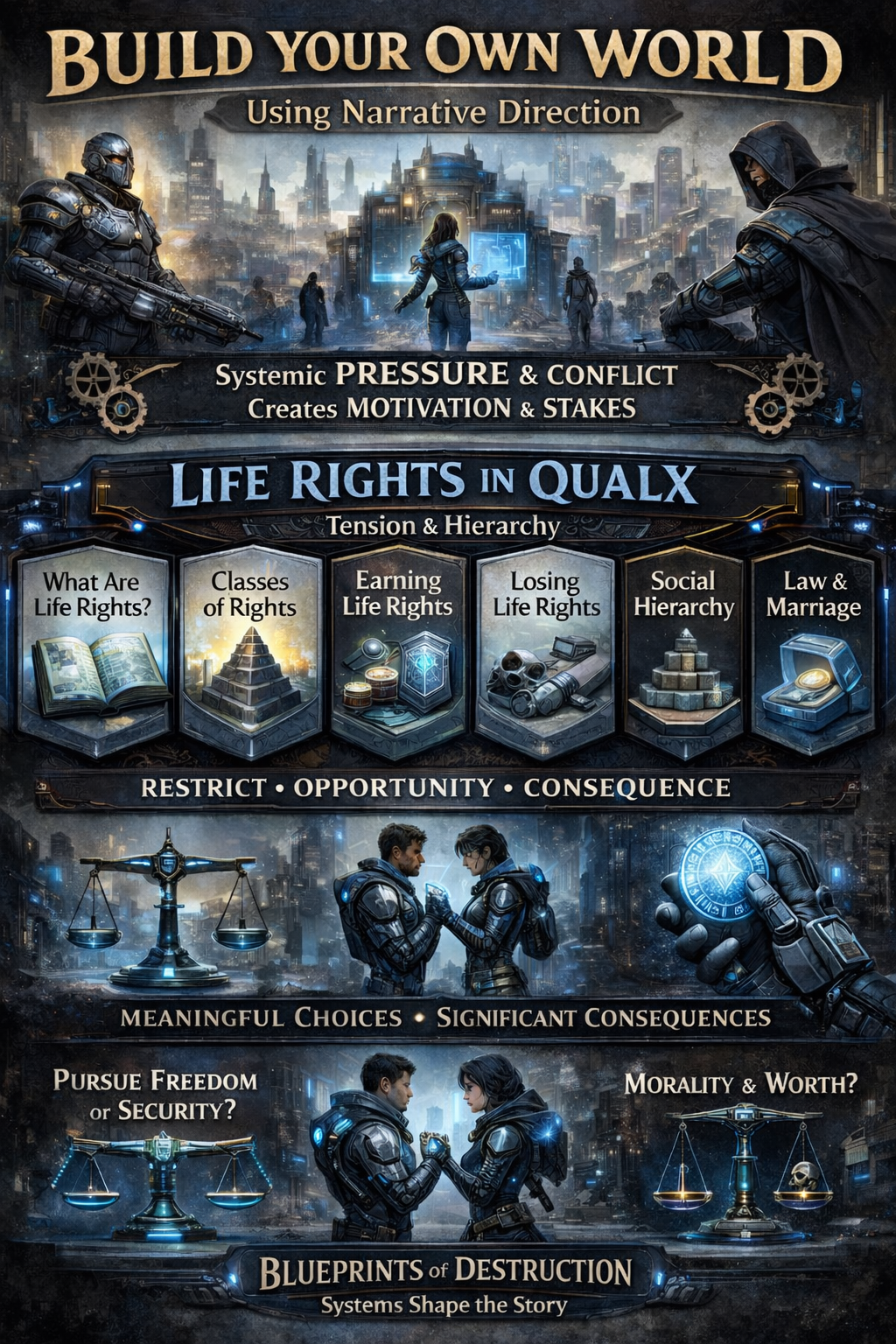
A form of pressure for characters inside of Qualx could be Life Rights. Life Rights are the perfect system to highlight this because it groups citizens into those with Life Rights, those without them, and those outside them.
If we break down Life Rights into eight clear sections, we can see how this kind of tension manifests itself in the world of Blueprints of Destruction.
- What Are Life Rights?
Definition, purpose, and cultural meaning. - Classes of Life Rights
Basic, Expanded, Immutable, and what grants or restricts rights - How Life Rights are Earned
Birth, granting, Guild service, marriage, duels, or through purchase - How Life Rights Are Lost
Crime, punishment, bartering, collateral, and reclamation - Life Rights and the Social Hierarchy
Citizens, unwrits, muzhii, debtors, and predators - Life Rights in Law, Business and Marriage
Contracts, unions, property, commerce, and inheritance
Build Your Own World Through Systems
In a well-built world you don't have to manufacture conflict. The system inside the world produces it for you. Conflicting incentives can emerge. Examples of conflicting incentives could be: what preserves safety restricts freedom, or what expands power risks ethical decay.
When characters pursue their own goals inside a complex system, they collide either with the system or with other characters who are also following their unique ambitions.
Social tension, as an example of a pressurized complex system, can be a heavy motivator inside a narrative. The character finds himself outside of his comfort zone, whether the system materializes this through power or danger. The character may have been pushed against his will, or may have stepped outside of it voluntarily. Either way that character's greater goal is being pursued, which forwards the story.
Conflict in your story is how stress is generated and pushed onto the characters. Pressure is what creates the character's movement, but simply moving characters from place to place has no greater impact on the story. Why does the character want to move in the first place?
To answer this, we need to look at character motivations.
Systems Give Characters Clear Motivations
Characters can't act in a vacuum. Instead, they act within structures. Through the motivations introduced by complex systems your characters are able to be directed through your world.
Complex systems create three different pathways for a character's actions. It can either restrict and put confines around what they can't do, give opportunities for what they can try. Alternatively it can impose consequences for what their actions will cost them.
By giving their motivations narrative weight, it makes both the actions that a character takes and the consequences of their choices feel necessary rather than arbitrary.
A character within the world of Blueprints of Destruction, for example, doesn't join the Guild "just because." They join because they have a goal of attaining Life Rights. This is to gain a better life for themselves and their family. Now their choice to join becomes emotionally and logically charged, instead of being an aimless selection.
But how do you make a character's choices have weight within your narrative?
In order to have meaningful choices, you must have meaningful consequences.
Build Your Own World Using Stakes
The key to every good story is not just about what the characters are doing, but it is also about what they are risking. Without stakes that feel real, the element of danger can be lost.
For stakes to feel real, there must be a chance that the character can lose something they find valuable. This can be either something that they already possess or something they are striving to attain.
As the characters progress through the story one effective way to increase the stakes is to begin to shrink the good choices a character can make. By giving the character fewer and fewer options, they are either forced to make sacrifices, or turn into the very thing they swore never to be.
Increasing the stakes helps to keep the reader engaged with the story you are telling. Heightened risk helps the audience stay invested and focused on the greater theme you are trying to convey.
Using Arcs to Build Your Own World
Entire story arcs can be built around how a character interacts with a system. There can be both character-driven arcs and plot-driven arcs.
An example, using characters within Qualx, a character-driven arc could be a story based on a character navigating Life Rights. An alternative arc might focus on a character as they strive for higher rank in the Guild.
Plot-driven arcs could be about systemic change, where the entire established boundaries of the story are flipped on its head. An economic collapse, a disruption to the system like a war beginning, or even a loophole that was discovered could all be changes to the greater system that serve as a valuable tool in propelling the story foreword.
The complexity of a system allows plots to feel like they emerge naturally from the world's internal logic. Just like a well-made system can progress the plot of your story, it can also give your narrative weight and meaning.
Once systems have shaped action and consequence, they can begin to shape theme.
Systems Drive Thematic Meaning
Systems allow themes to become tangible. Life Rights as a tangible system aren't just mechanics but a metaphor for the wider world.
Whether your theme is about freedom versus control, or identity versus the whole, you can use the systems embedded in your world to further emphasize the point you want to make.
For example, in Qualx, Life Rights transform from a complex system into a lens through which morality can be viewed. Life Rights elevate a simple story into a powerful message about what a person owes, what a life is worth, and who gets to decide.
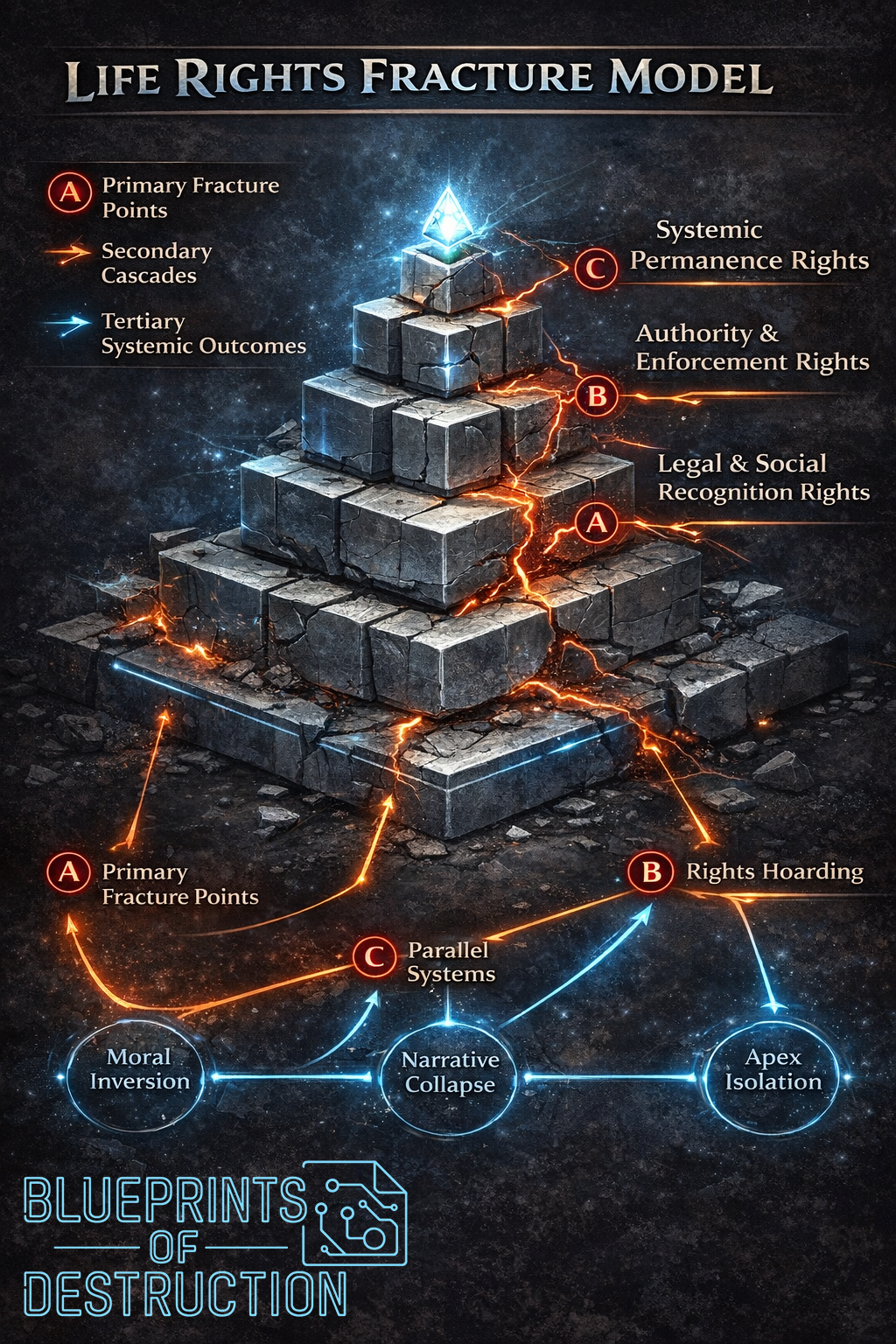
Whether it is in your quest to build your own world, or on your journey to create better character arcs, it is important to remember that systems help build pressure. As pressure is built, your character is forced to make a decision. Every decision your character makes comes with a consequence. Through the accumulation of choices and consequences, your story will begin to take on its own meaning, and perhaps even form its own kind of Blueprints of Destruction.
Life Rights Table of Contents:
How to Write Better Stories with Complex Systems
Build Your Own World by Expanding Complex Systems
How to World Build Through Lore
Exploring What is World Building With Tiers and Rights
Make Your Own World by Breaking Concepts Down
Using Worldbuilding Ideas to Create Intricate Systems
Creating an Imperfect System with Tips for Worldbuilding
Building Worlds With Consequences
How Life Rights can be Acquisitioned
