StoryStorm
A Creative Network for Blueprints of Destruction
StoryStorm is a place where ideas are preserved and developed. It is a space where sparks of creativity are allowed to exist unfinished, unrefined, and in motion. It is a home for ideas, regardless of whether they are fully developed or still taking shape.
Fragments of characters sit beside incomplete timelines. A species concept bleeds into a transportation system. A single trait becomes the center of an unexpected conflict.
Nothing is wasted.
Storystorm does not require a full plot. It isn't looking for a complete character. You don't need to know where the story is going.
All you need is a trait, a moment, or a question. Those fragments are more than enough. One small spark is often all it takes to ignite the process needed to develop a concept.
Creative Preservation of Ideas
Why Writers Should Keep Their Unused Ideas
In PhranqenLu's experience, many writers throw perfectly good ideas away because they judged the idea too quickly. A new idea may look silly, incomplete, shallow, or unusable at first. Perhaps an idea a writer was already using may begin to seem as thought it is obsolete because of new information they uncovered in the worldbuilding process.
Just because an idea looks like it is useless or no longer fits the story does not mean that the idea is worthless. It may only mean that the idea is simply half-baked.
An unused or even a discarded idea is not a bad idea. Sometimes it is:
- A good idea in the wrong place.
- A big idea that needs more skill.
- A small idea that needs to fit inside a bigger concept.
- A strange idea that needs time to mature.
- A rough idea that only needs pressure, conflict, and purpose.
- A good idea that only needs to be looked at in a different context, or under a different light.
The Potential of an Unused Idea
Extremely early on in the story development process, Frank urged Lucy to keep every idea, no matter how outrageous, silly, or undeveloped (usually, that just means under-developed) it seemed.
The one and only rule of Storystorm was that an eraser could never be used, except to correct minor mistakes like spelling.
Initially, Lucy thought this was an outrageous idea. Preposterous, even. But now that PhranqenLu has spent years writing and worldbuilding, many ideas that once seemed useless have proven far more valuable than originally understood. More times than PhranqenLu can count, an old idea resurfaced (or was simply viewed from a new perspective) and fit perfectly into place where it was needed.
When creating ideas for a story, a world, or a character, the goal is not to instantly create perfect story material. Storystorm, more than an idea "generator", is an idea "keeper". Some sparks become scenes. Some become characters. Some become entire worlds.
For PhranqenLu, many sparks sat quietly on a page until the ideas slowly began to ignite into flames. Those small fires started to cast light on their potential for greater understanding. In some cases, what started as campfires became a blaze of worldbuilding. You might even say, what started as StoryStorm turned into Blueprints of Destruction!
Keeping an idea bank, where you deposit all of your sparks, snippets, and half-developed ideas, might not only become useful, but may end up changing the entire course of your story in a powerful way. Many times in an unexpected way.
To learn more about the beginning of this process, read How StoryStorm Began: Using Limits to Discover a Story.
Step Into the Storm
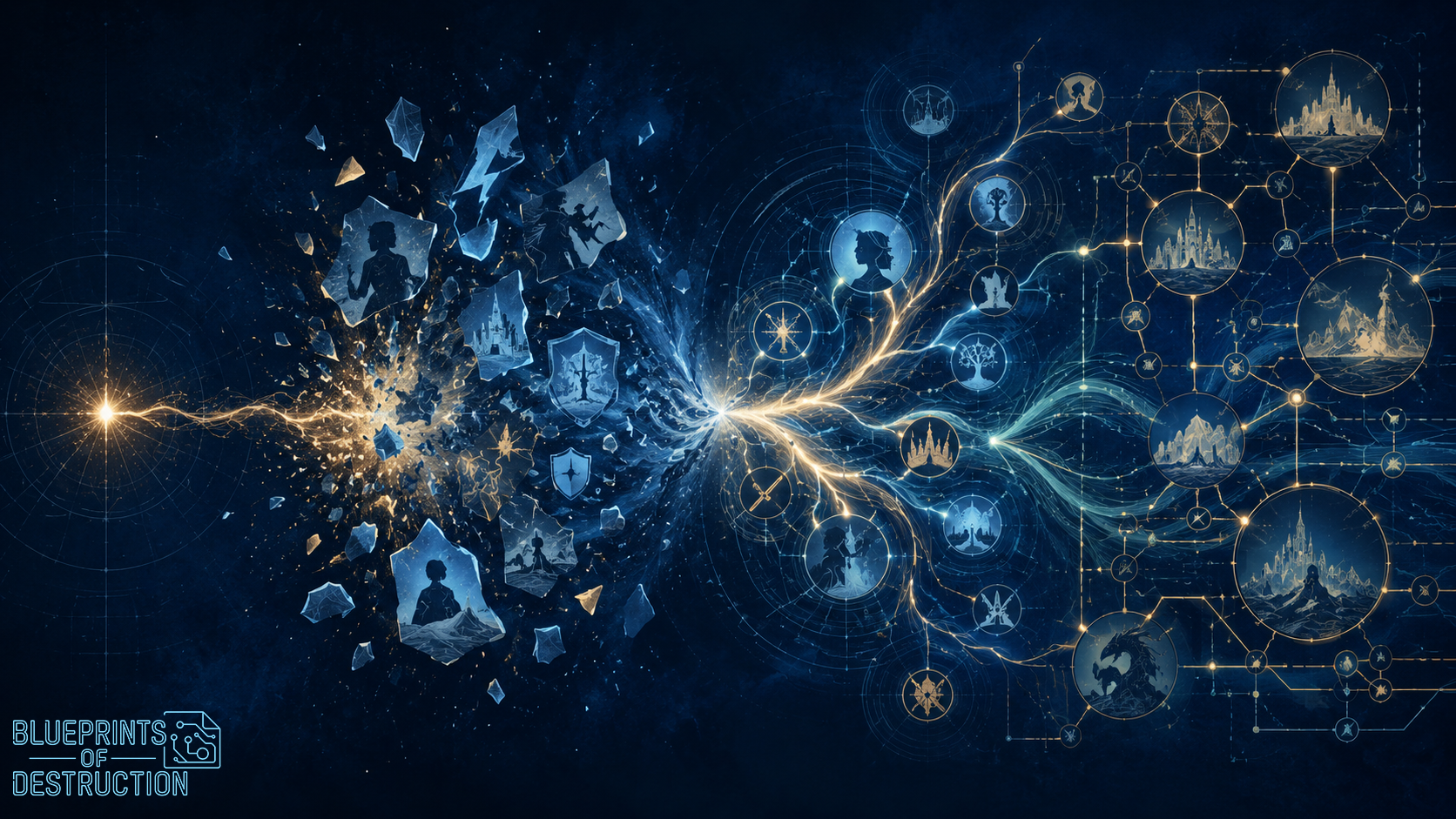
In Storystorm, ideas do not stay isolated. They press against one another. They blend, shape, or reshape the ideas around them.
A system becomes a problem. That problem becomes pressure. Pressure reveals the story.
Whether you decide to use a physical notebook or a digital one, it is time to step into a storm of ideas that are entirely your own.
Start anywhere. Generate something. Follow what catches your attention. You don't need a map, or even a plan.
You merely need to start.
If you do not feel prepared to start just yet, that is okay. Just because you are feeling unprepared does not mean that the stories within you are any less valid. You may never know who is waiting to explore your world, with just as much (or more) excitement than you have.
You are invited to take a closer look at PhranqenLu's StoryStorm: to retrace ideas, follow the development of their world, and discover where those ideas ultimately led. And when you finally realize that your ideas are worth the thrill of entering the storm, you may find that you are far more prepared than you thought.
Choose Your Entry Point
The storm doesn't have a single path. Every element touches another and builds into something larger. You can begin with a character, a world, a concept, or even something you don't quite yet grasp.
Choose where to begin.
No matter where you begin, the process is the same. Ideas collide. Pressure builds. Something begins to take shape.
How Fragments Become Fiction
Storystorm takes loose ideas and helps turn them into usable story material.
How the Storm Works
Storystorm is not about forcing every idea into place right away. It is about giving ideas room to appear, collide, and become useful over time.
Capture the Spark
Begin with anything: a character trait, a strange image, a worldbuilding detail, a line of dialogue, a species concept, or a problem that has not found its place yet.
Let Ideas Collide
Do not isolate the idea too quickly. Let it touch other parts of the story. A character can collide with a system. A species can collide with a city. A timeline fragment can collide with a secret.
Add Pressure
Pressure turns an idea into story. Ask who is affected, what breaks, who benefits, what changes, and what someone must choose when the idea becomes real.
Shape the Fragment
Once pressure reveals meaning, the idea can become something usable: a scene, character arc, faction detail, conflict, rule, timeline event, or note to save for later.
You don't need to follow these steps in order. You just need to start somewhere.
Not every idea will become a story. But every story begins with something small: a fragment, a question, or a collision.
That is what this space is for.
When you are ready to build from your own sparks, explore the Story Development Tools. For a broader map of related resources, visit the Writing and Worldbuilding Page Directory.
