Writing: How to Turn an Idea Into a Draft
Writing is about the communication of ideas. Story writing, when boiled down to its essence, is about creating something that is meaningful and emotionally powerful.
This page is intended to help you understand the practical process of writing a story: how ideas are shaped into structure, how structure guides individual scenes, and how those scenes come together to form a draft that can be evaluated, revised, and refined.
Before we dive into how to mold your ideas into a narrative, we first need to understand the core components that make up a story.
Key Components
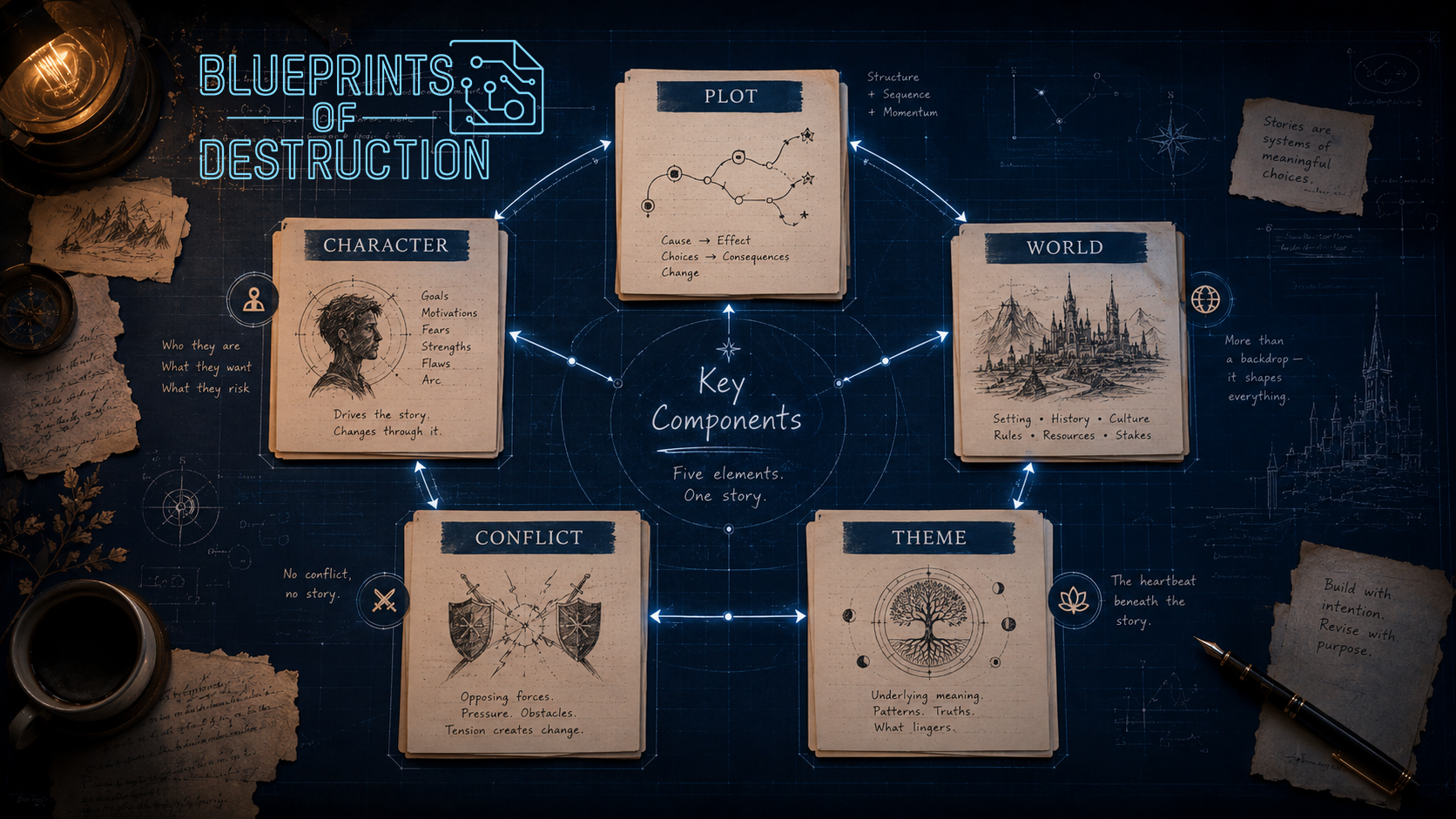
The following components are only introduced here briefly. This page's intent is to focus on the process of written scenes, not of the mechanisms behind creating a scene.
Character Development in Stories
In story writing, the word character commonly refers to two connected ideas. First, it may refer to an individual presence within a narrative: a person, creature, entity, or personified object capable of affecting the story through its choices, behavior, or influence. Second, it may refer to the qualities that distinguish that individual from others, including their traits, values, habits, fears, and tendencies.
These qualities become meaningful when they are expressed through behavior. In storytelling, character is revealed through patterns of action, especially when pressure forces an individual to make a choice. Traits may describe who a character appears to be, but decision under pressure demonstrate who that character is.
Plot
Plot is the string of cause, effect, and consequence that is created as a result of pressure over time. If nothing changes within the story, then there is no plot.
The World within the Story
Rules, environments, and cultures each contribute to the setting of a story. The setting, along with its surrounding events, make up the world. The world can be a source of pressure within the narrative. This can go beyond simple background and become active resistance for your characters as the plot is moved forward.
Conflict in Storytelling
Conflict is incompatibility magnified by pressure. It begins when two or more needs, goals, values, beliefs, or conditions cannot exist together without creating tension. However, incompatibility alone is not always enough to move a story. The characters may ignore the problem, delay making a choice, or find an easy compromise.
Pressure removes those easy exits. It forces the characters to respond before they are ready, make sacrifices they would rather avoid, or choose between outcomes that each carry a cost. The greater the pressure becomes, the more clearly the conflict reveals what the characters value, what they fear, and what they are willing to do.
A lack of pressure results in weak conflict because there is nothing to force the incompatibility to become consequential. Strong conflict does more than place obstacles in a character's path.
Properly constructed conflict is the narrative tool that makes it increasingly difficult for a character to remain unchanged.
Theme
Theme is the deeper idea or lesson that grows from the events of a story. It becomes visible through repeated choices, struggles, and consequences. Theme is not just what the story says. It is what the story reveals through the connection between what characters do, what those actions cause, and what outcomes that follow.
Where Ideas Come From
In order to form ideas into a draft, you first need to have an idea. If you are struggling with a way to start a story, some resources are:
- Random Character Generator
- Story Prompt Generator
- Storycraft
- Storystorm
- Using Randomization to Start Writing
Once you understand the separate pieces of a story, the next step is arranging them so they create movement.
Structure
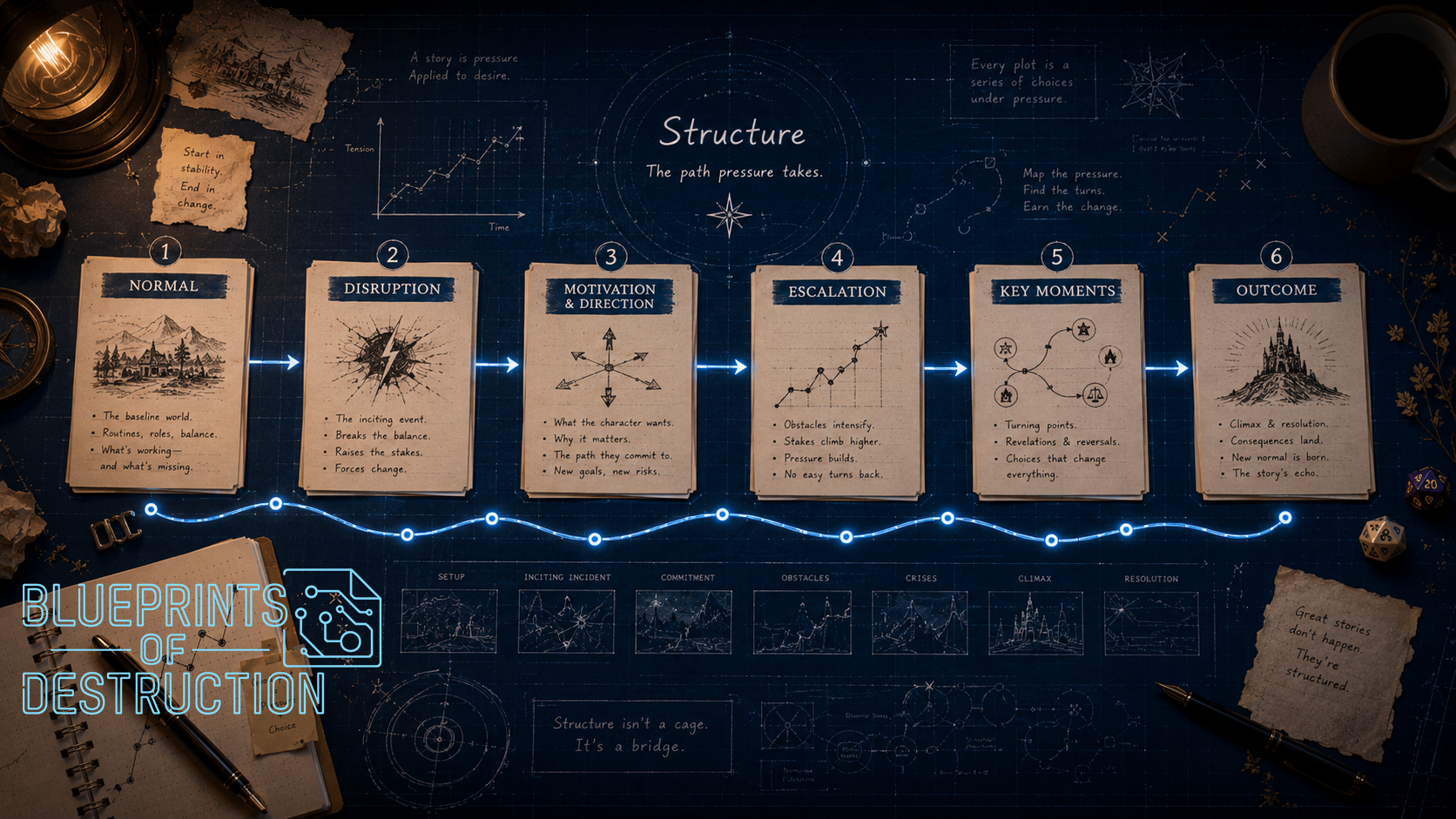
Structure is where a story begins to take shape. It is the combination of information, meaning, and pressure. Structure is not a cage that ideas are forced into, but are the boundaries that the path gravitates to. This is what takes a pile of interesting pieces and lays them down for the reader to follow.
Structure Resources:
- How to Plan a Story Before You Start Writing
- Plotting a Story
- Story structuring guide
- Escalation path worksheet
- Key moment design
- Cause and Effect in storytelling
- How to build a story spine
Choose Your Writing Path
New to Writing?
Continue along the beginner pathway if you need help turning an idea into a usable story seed.
Already Building a Story?
Follow the more advanced pathway if you are looking to strengthen structure, pressure, pacing, and meaning.
Writing (as a Beginner)
Beginners often think that they need to fully develop a story before they begin. The opposite is true: you do not need the whole story, just one viable idea to open the door.
Resources on starting a story:
- How do I begin a story
- Writing: How to Turn an Idea Into a Draft
- Story ideas for beginners
- Using randomization to start writing
- "What if?" questions for writers
Building a Scene
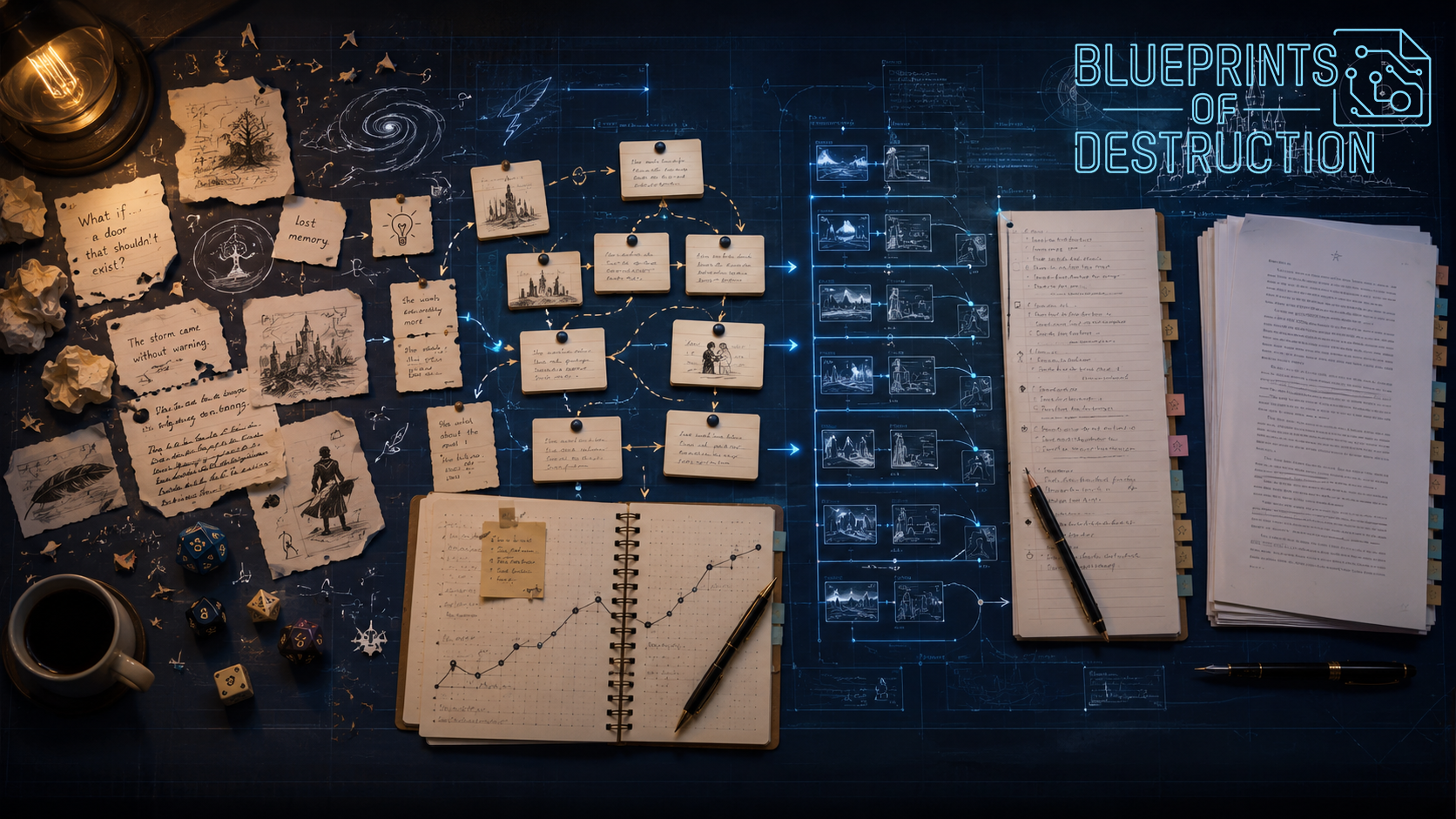
A scene should include:
- Setup
- Pressure
- Decision
- Outcome
Scenes are where writing becomes real. They force a writer to stop thinking abstractly and begin shaping moments.
Scene Writing Resources:
- How to Write a Scene
- Scene Structure for Beginners
- Writing: Decisions Under Pressure
- Under Pressure: Dialogue
Repeat
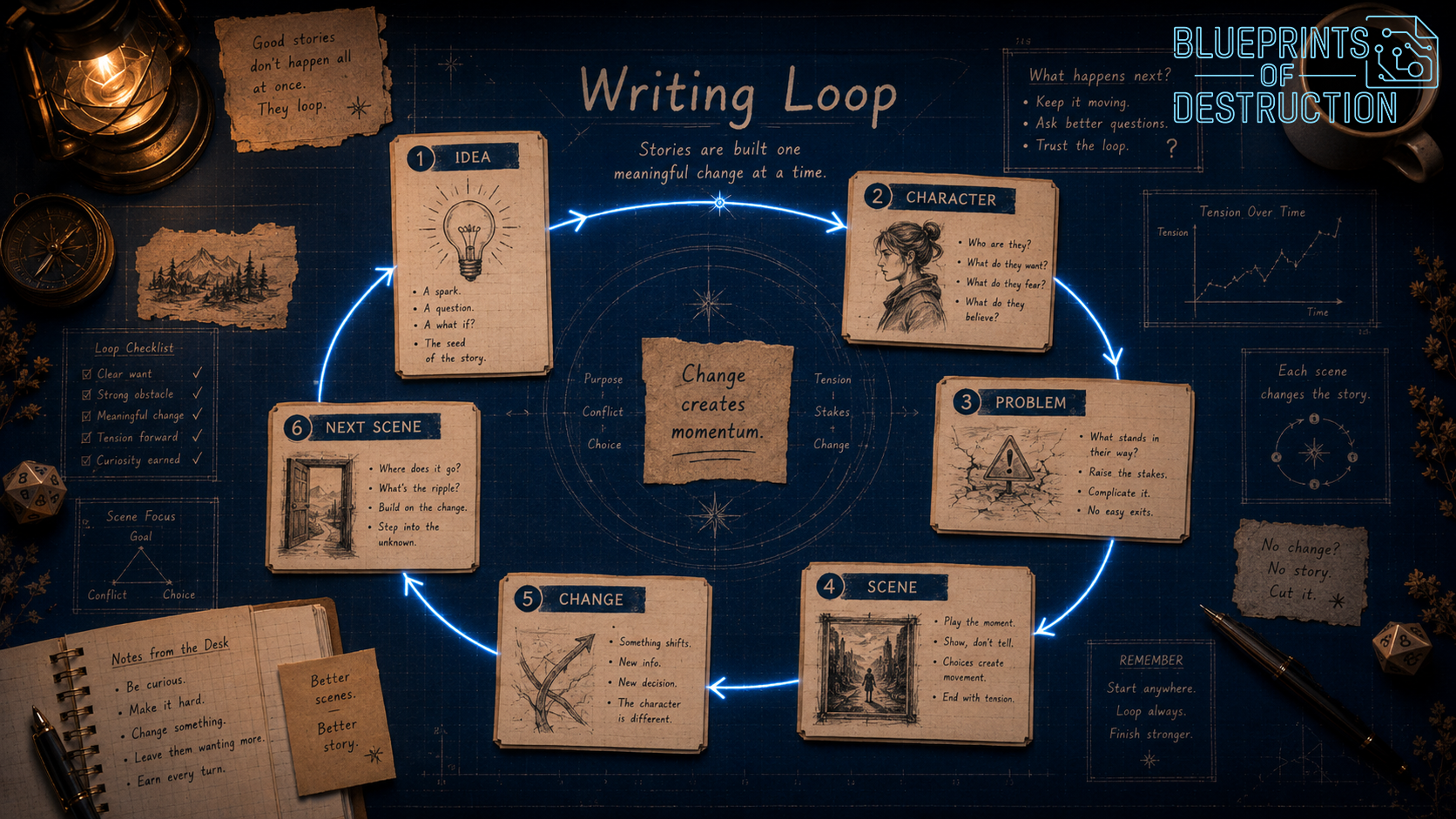
Stories are built from one meaningful change at a time, even if those transformations are small.
The loop that repeats is:
Idea → Character → Problem → Scene → Change → Idea → Character, etc.
Need help continuing the loop?
- Scene Writing Workspace
- Writing Routine for Beginners
- From Scene to Story
- How to Build a Story Step-by-Step
What Counts as Progress?
Progress is not always word count. Progress might look like clarifying a scene, discovering what needs to be changed, or identifying why a scene isn't working. Sometimes, progress can be removing elements, which could be entire pages or even whole chapters, that don't serve what the story needs. This means there are times the best way to add to your story is by taking something away.
Just like a story is built by small changes, so is a draft. Each change, no matter how big or small, is a part of improving your writing. Part of progress can also be refining your work to better align scenes, pressure, pacing, and meaning. Revision is not failure. It is part of the process to help your draft become more clear.
Need Help Staying Connected to the actual writing?
- Don't Forget to Write
- Writing Routine for Beginners
Strengthening the Draft
Once you have the basics of writing, the goal is no longer adding story pieces. Each element already exists. It is about helping every piece of the story work together.
If you are struggling with:
- Your story feeling flat
- Your story dragging in the middle
- Your scenes not connecting
- The theme feeling forced
- Revision feeling endless
Then this section is for you.
Advanced revision begins with diagnosis, not polish. Before you can fix your story, you first need to identify what is missing, or could use some reinforcement.
Need help diagnosing your story?
- Story Diagnosis Checklist
- Finding Weak Scenes
- Why a Story Feels Flat
- Narrative System Analysis
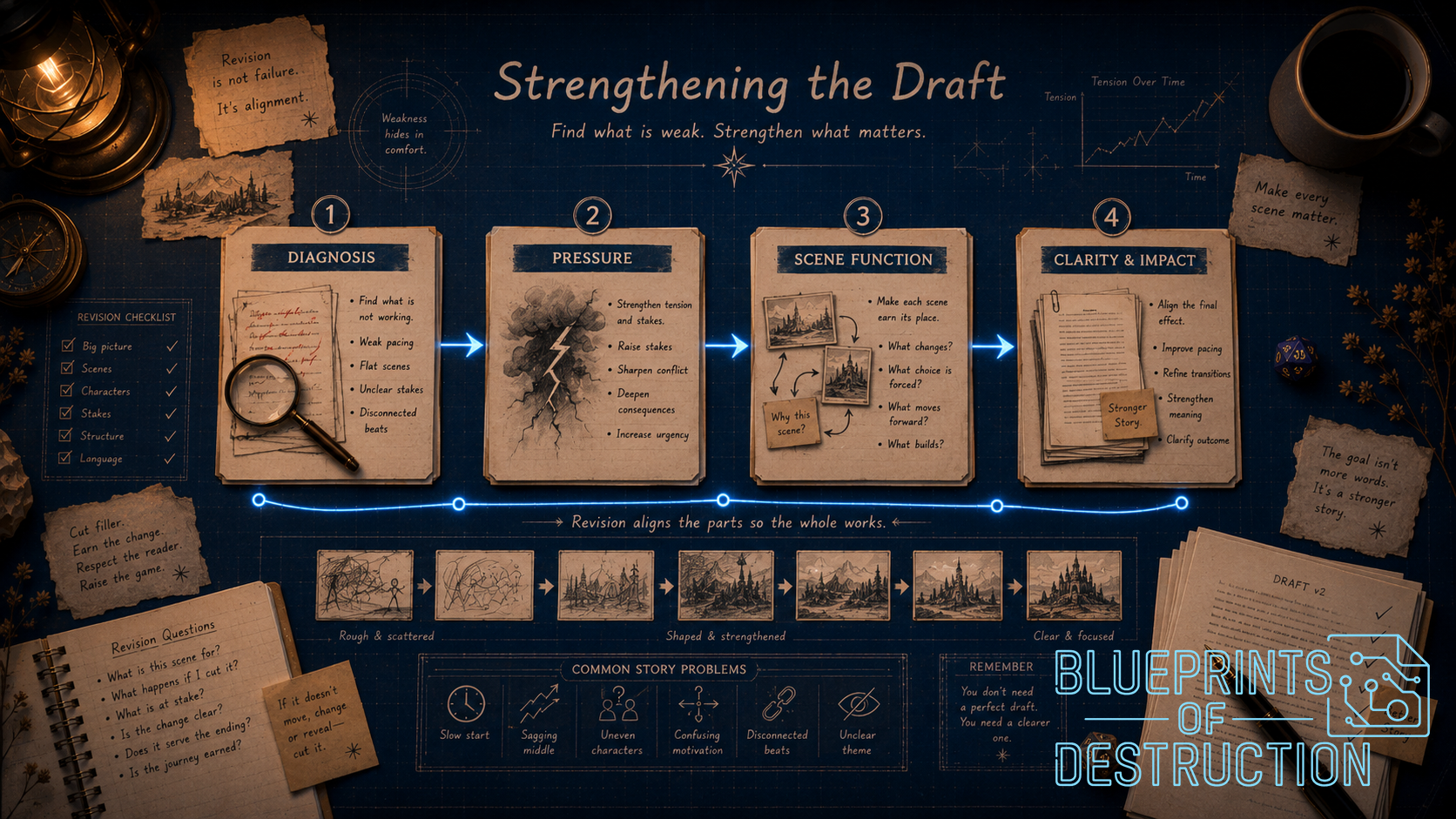
Scene Refinement
A scene should be evaluated on its function, not just whether it is interesting or not. This is about fine tuning everything from pacing and revision, to transitions and character behavior. For each scene, ask:
- What pressure appears here?
- What decision is forced?
- What changes by the end?
- What does this scene make possible next?
A scene should earn its place by changing the story. Advanced scene evaluation prevents unneeded filler and strengthens the pacing.
Need help strengthening your scenes?
Scene Refinement Resources:
- Scene Function Checklist
- Fixing Filler-Scenes
- Scene Transitions
- Writing Strong Scene Outcomes
Draft Refinement Resources:
- Story Diagnosis Checklist
- Strengthening Weak Conflict
- Modify Pacing
- Editing for Pressure and Clarity
From Idea to Story
The story becomes clear as you build it.
Writing starts as a small idea. Every story begins as a possibility. Structure gives it direction. Pressure gives it motion. Scenes give it form. Refinement gives it clarity.
Storytelling is not reserved for the naturally gifted. Writing is a process of shaping ideas through structure, pressure, scenes, and refinement. You don't need a perfect idea, or even the perfect execution, in order to be a writer.
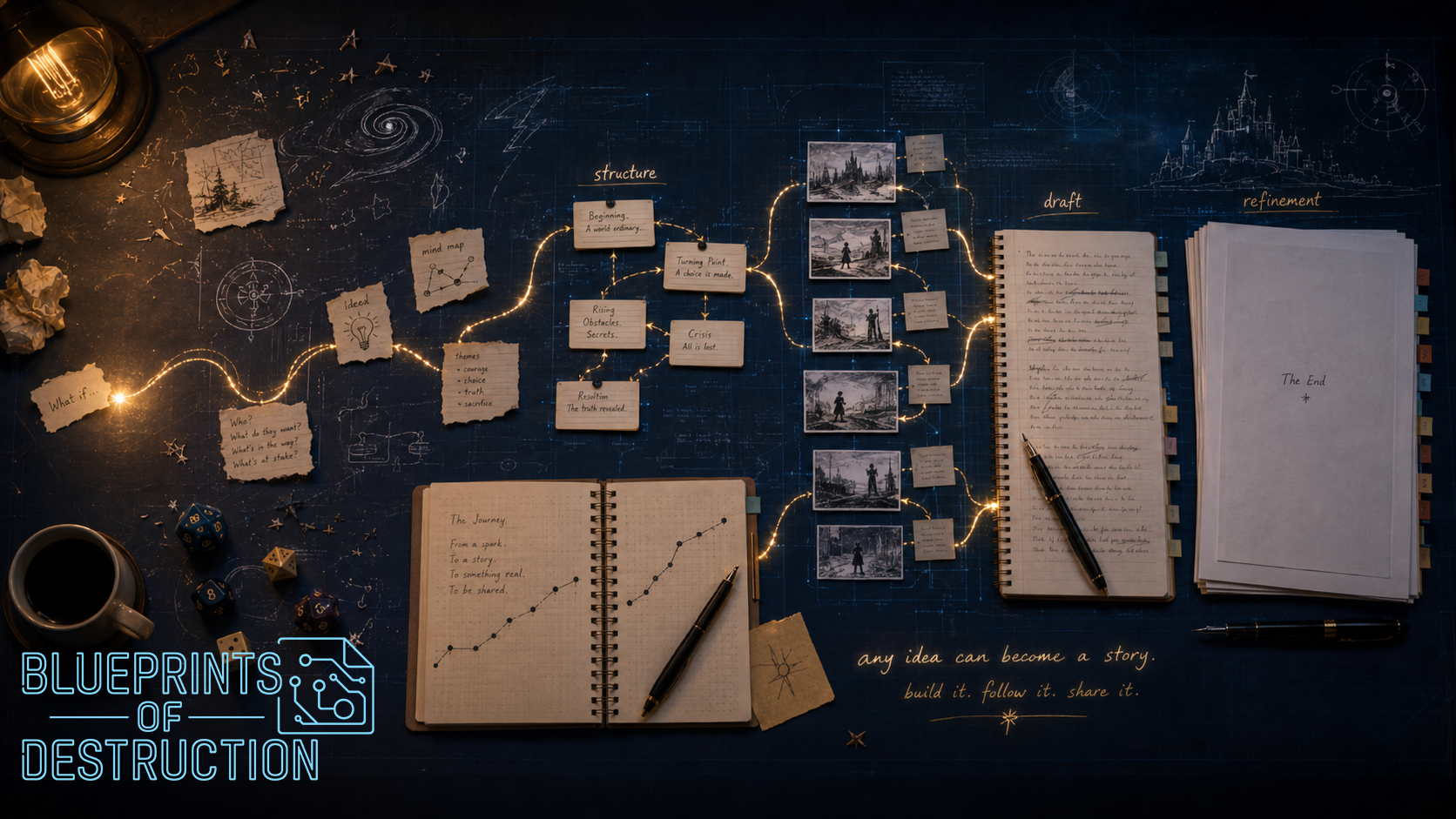
Any idea can be shaped into a story, and all it takes is a single spark of imagination to create something truly powerful. Writing improves through practice. Confusion and frustration can be part of the process. If you feel like you hit a roadblock in your path, do not give up. We can get past this roadblock together!
Not sure where to begin?
- New to writing? Follow the Beginner Pathway.
- Working on a draft? Use the Advanced Pathway.
- Need inspiration? Try a generator, a prompt, or explore ways to generate ideas.
- Stuck in the middle? Study structure, pressure, and scene function.
Now the journey is in your hands. Choose one idea, place it under pressure, and write the moment where something changes.
