- Home
- Step-by-Step Story Writing
- Worldbuilding Tools
Worldbuilding Tools
How does political hierarchy function in your story? Political hierarchy is one of many powerful worldbuilding tools. Does your world have a centralized government or is it composed of many autonomous city-states operating under a shared banner?
Before we rummage around much further in our toolbox, lets review the core questions you can ask in order to help develop your worldbuilding tools.
Fifteen Core Questions of Qualx (Collapsible)
Fifteen Core Questions of Qualx (Collapsible)
Structural and Foundational Questions
1. Founding Principle: What was the original purpose or event that led to the formation of Qualx's governing body?
2. Power Source: Who or what grants authority in Qualx? Is authority granted by the people, an inherited class, or divine mandate?
3. Political Hierarchy: Does Qualx have a single central government, or multiple autonomous city-states that operate under one banner?
4. Guilds and Governance: How does the Guild function within the overall government structure? What groups, arms of government, organizations, corporate entities, or separate power blocs interact? Who negotiates with whom?
5. Citizenship and Life Rights: How are Life Rights granted, suspended, revoked, or used as currency? And who has the authority to execute and activate these transactions?
Administrative and Legal Questions
6. Law Enforcement: Who enforces law and order in Qualx? Is it a police-like structure, a military force, mindless automatons, Guild-appointed agents, or is there something darker and more mysterious at play?
7. Judicial System: Who administers justice? Are there trials, arbitration councils, judges, natural disasters sent by gods, or Guild tribunals?
8. Economic Control: What serves as currency in Qualx? And is the economy state-run, Guild-driven, capitalist, resource-based, or is it some kind of hybrid system?
9. Territorial Management: How is land and resource distribution managed? Is there private ownership, state assignments, or a link between Life Rights and the acquisition of raw materials?
Cultural and Ideological Questions
10. Core Ideology: What is the prevailing philosophy or moral compass of the government or people? What mindset helps determine order, progress, control, or survival?
11. Religion and Power: Does religion have any role in Qualx? If so, is it used to legitimize or challenge authority?
12. Information Control: How is knowledge and communication regulated? Is it open and free, heavily censored, or filtered through some kind of in-story gatekeeper or censor?
Political Dynamics
13. Conflict and Rebellion: What forms of dissent exist? Are there underground movements, rival factions, sanctioned opposition, or is it a free-for-all?
14. Military Role: If there is an army? Is it a protector of the people, an enforcer of the regime, or is it fragmented and bureaucratically useless?
15. Foreign Relations: Does Qualx interact with other peoples, nations, or worlds, or is it isolated and self-contained?
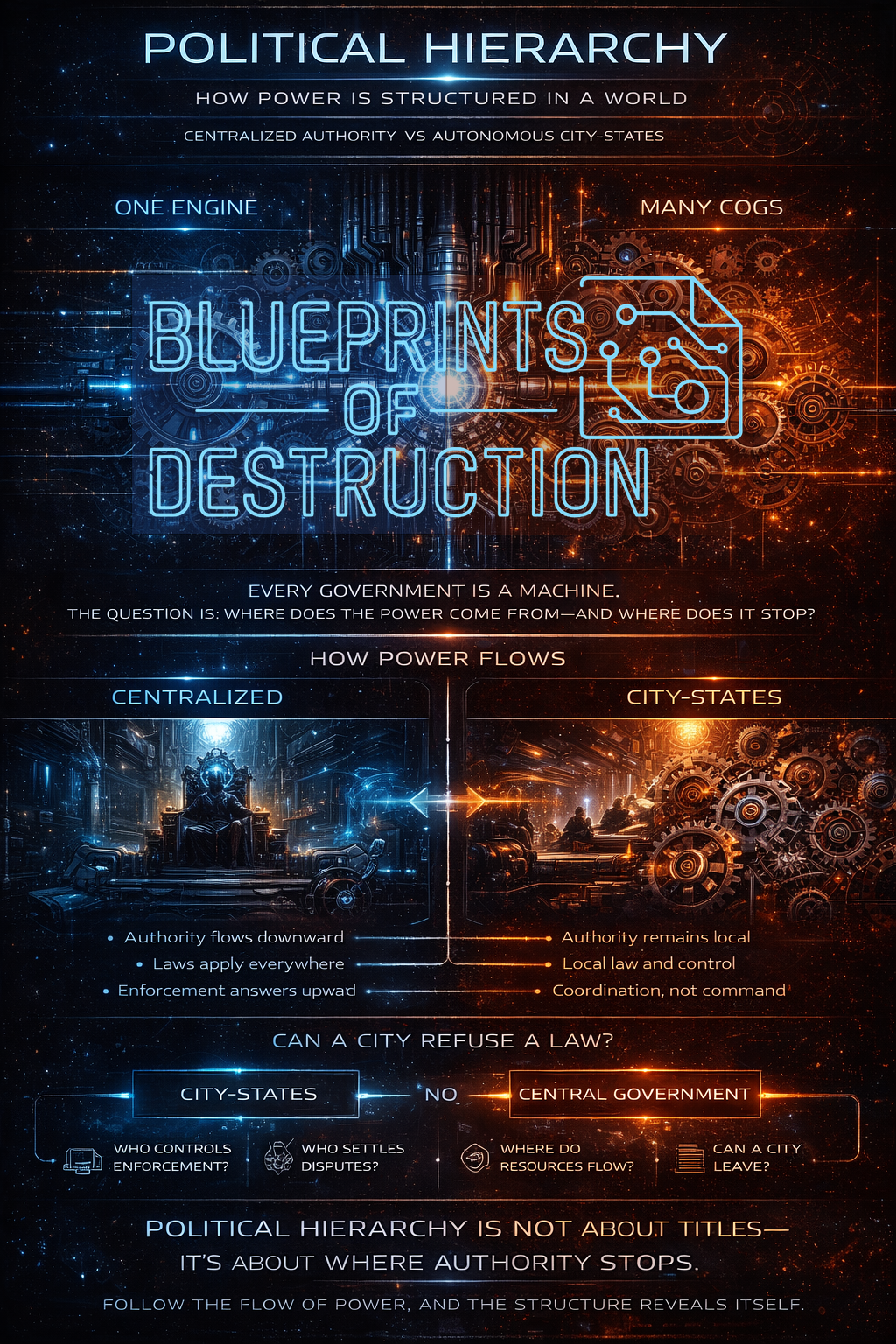
Let's take a closer look at the way the government exercises its political hierarchy, and how that impacts your narrative. Does it function as a standalone engine, or is it a compilation of many cogs working together? Which system might be a better fit for the machinery of your story?
Political hierarchy is not decided by simply labeling your government as one type or the other. To properly classify a government, it must meet certain criteria. To determine this, it is necessary to observe how decisions are made and where authority begins, and ultimately stops.
While the defining traits of government are important, it can be helpful to examine how the differences between systems clearly distinguish one type of political hierarchy from another.
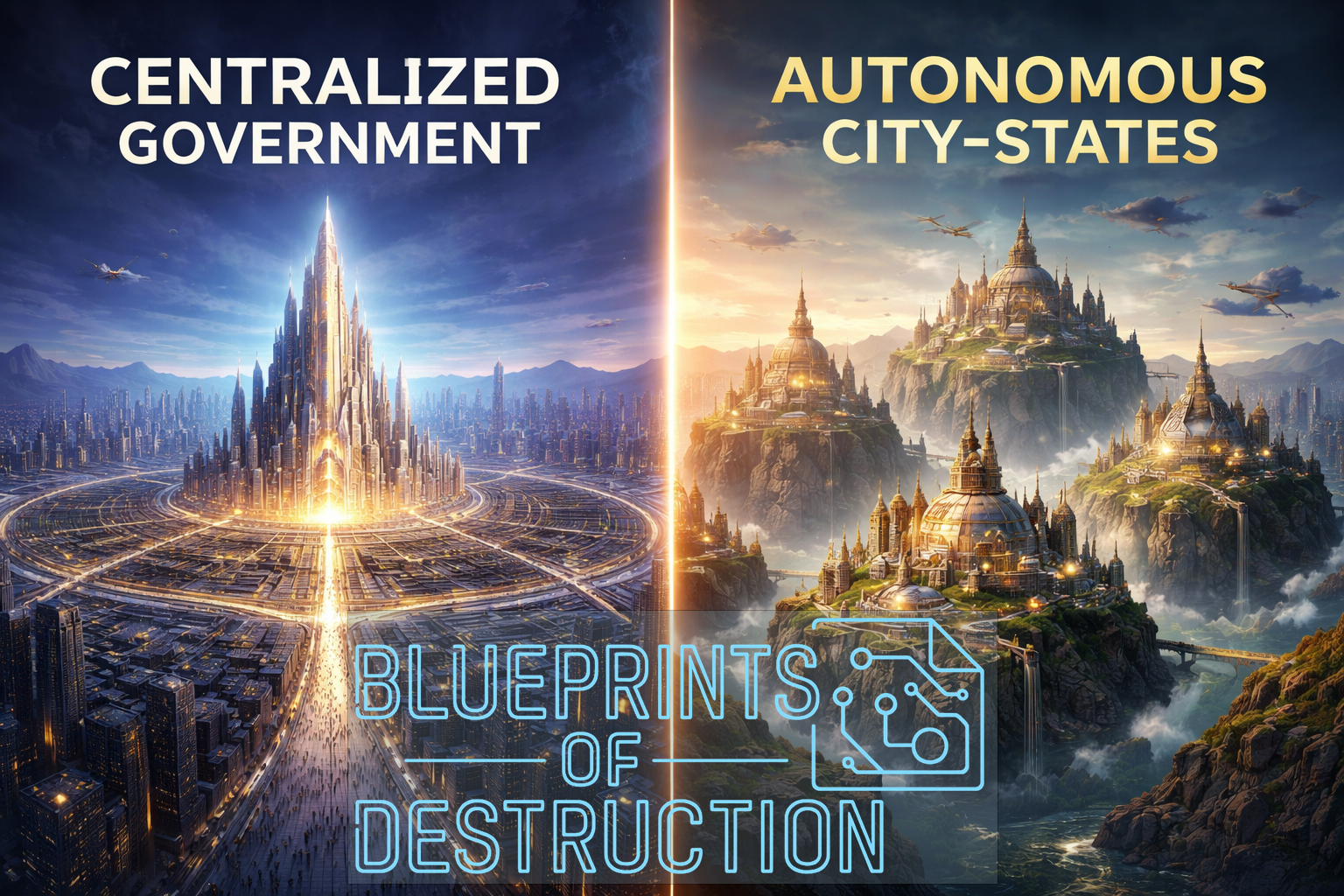
Core Differences
The first step in figuring out how your world's government functions is to understand what each category means.
A single, central government is one authority that establishes rules that apply everywhere. Once these rules are made, local leaders carry them out. In a central government, local differences may exist, but permission flows downward.
In contrast, multiple autonomous city-states under one banner govern themselves day-to-day. The overarching "banner" may coordinate or arbitrate, but it does not command. In the case of these small city-states, authority is lateral, not vertical.
Creating an entire government can feel overwhelming at times. To avoid taking on too much at once, it might help to take a "magnifying glass" approach and examine one part at a time. Rather than trying to understand everything at once, looking at the individual components separately from one another can help develop a single aspect of your world's government. Once you take a step back, the system as a whole can be easier to digest.
If you aren't sure about what kind of government your world has, the following clarifying questions can help:
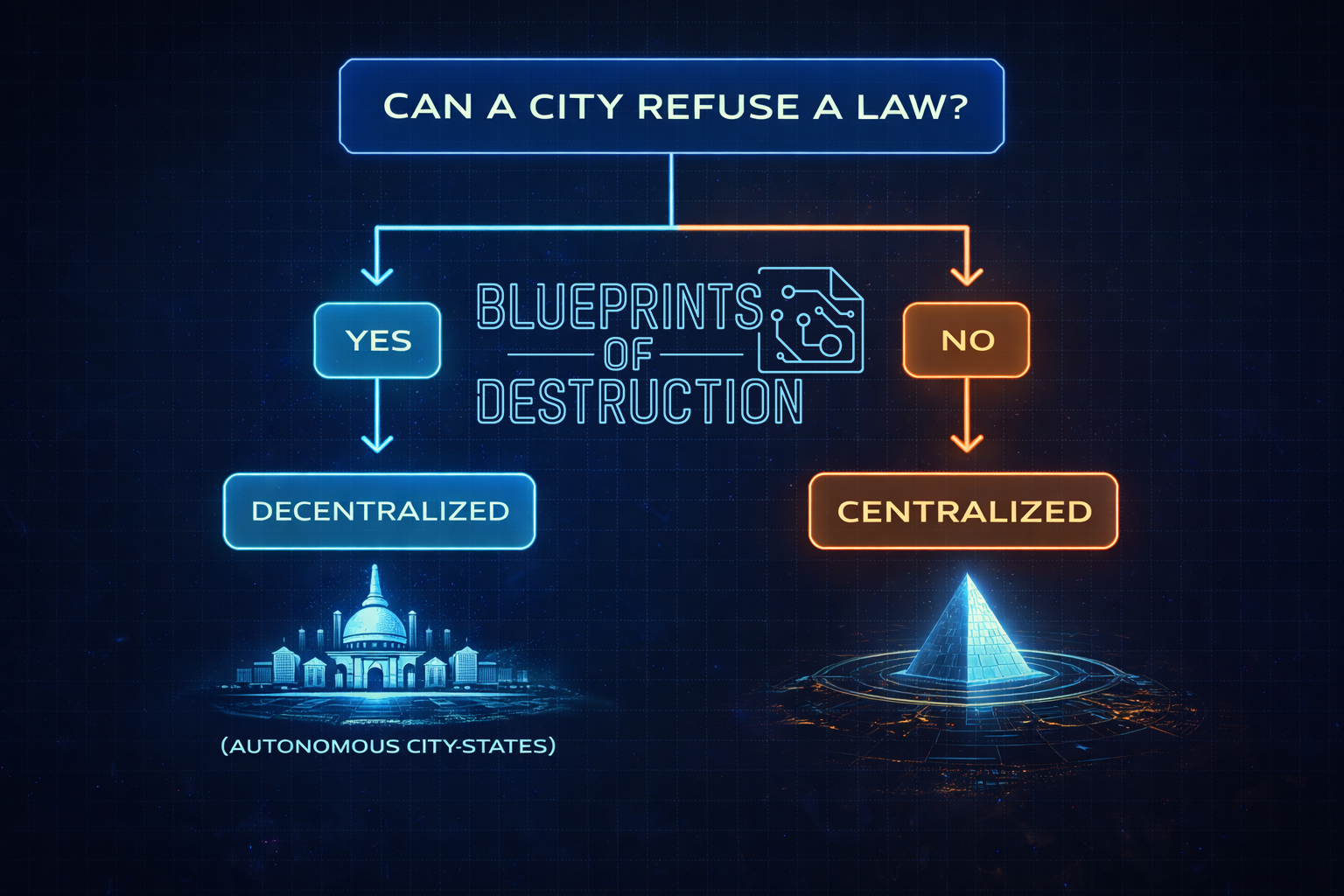
- Can a city refuse a law?
If the central authority passes a law, can a city legally say no? If no, you have a central government. If yes, you have city-states. - Who controls the enforcement inside the city?
Are police or military forces loyal to local authorities, or to the central government? If enforcers answer to the center, you have a central government. If enforcers answer to the city, you have a city-state system. - What happens when two cities disagree?
Who settles disputes? If a higher authority issues binding rules, the government is central. If cities negotiate, bargain, or threaten one another, then they are city-states. If a council mediates without enforcement power, the result is city-states under one banner. - Who collects the most important taxes or resources?
Where do the vital resources ultimately go? If resources are collected centrally and then redistributed, the government is central. If resources are collected locally and dues are paid upward, then the system is city-states. - Can a city leave?
Is separation illegal, unthinkable, or merely dangerous? If leaving is impossible or illegal, the government is central. If leaving is possible but costly, the system is city-states. If separation is common, the system is a loose confederation.
These questions are meant to be a resource, not a mandatory checklist that bogs the gears. Take your time and answer each one in a way that best fits your story. If you can answer these questions, you are well on your way to building a setting with a rich, established history.
Quick Check
As a final test, ask yourself:
If the title of a news headline was "City ___ defies central authority" what would the result be?
- If the answer is treason, you have a central government.
- If the answer is politics, you have independent city-states.
Political Hierarchy in Qualx
The narrative application of Qualx's political hierarchy is relatively simple. Qualx occupies a vast amount of space, yet is only a single city ruled by one central authority. While its sectors and subsectors differ in function and structure, they all answer to the same system of rule.
Practical Application of Worldbuilding Tools
Developing an entire world can be a formidable task, but once the work is done, the result is a powerful resource inside of an entire box of worldbuilding tools that enhances your narrative. When development is canonized, the execution of your world can feel seamless and natural.
If this feels like a lot, that's okay. Worldbuilding is about asking good questions, not having perfect answers right away. Asking questions helps test your ideas as you look at the larger backdrop of the world you are creating.
The more effort and time you put into developing your world and story, the closer you get to unleashing your inner author!
