- Home
- Step-by-Step Story Writing
- Create a World
Create a World
Before we breakdown the founding question for this page, let's review the fifteen core questions we are asking our story:
Fifteen Core Questions of Qualx
Structural and Foundational Questions
1. Founding Principle: What was the original purpose or event that led to the formation of Qualx's governing body?
2. Power Source: Who or what grants authority in Qualx? Is authority granted by the people, an inherited class, or divine mandate?
3. Political Hierarchy: Does Qualx have a single central government, or multiple autonomous city-states that operate under one banner?
4. Guilds and Governance: How does the Guild function within the overall government structure? What groups, arms of government, organizations, corporate entities, or separate power blocs interact? Who negotiates with whom?
5. Citizenship and Life Rights: How are Life Rights granted, suspended, revoked, or used as currency? And who has the authority to execute and activate these transactions?
Administrative and Legal Questions
6. Law Enforcement: Who enforces law and order in Qualx? Is it a police-like structure, a military force, mindless automatons, Guild-appointed agents, or is there something darker and more mysterious at play?
7. Judicial System: Who administers justice? Are there trials, arbitration councils, judges, natural disasters sent by gods, or Guild tribunals?
8. Economic Control: What serves as currency in Qualx? And is the economy state-run, Guild-driven, capitalist, resource-based, or is it some kind of hybrid system?
9. Territorial Management: How is land and resource distribution managed? Is there private ownership, state assignments, or a link between Life Rights and the acquisition of raw materials?
Cultural and Ideological Questions
10. Core Ideology: What is the prevailing philosophy or moral compass of the government or people? What mindset helps determine order, progress, control, or survival?
11. Religion and Power: Does religion have any role in Qualx? If so, is it used to legitimize or challenge authority?
12. Information Control: How is knowledge and communication regulated? Is it open and free, heavily censored, or filtered through some kind of in-story gatekeeper or censor?
Political Dynamics
13. Conflict and Rebellion: What forms of dissent exist? Are there underground movements, rival factions, sanctioned opposition, or is it a free-for-all?
14. Military Role: If there is an army? Is it a protector of the people, an enforcer of the regime, or is it fragmented and bureaucratically useless?
15. Foreign Relations: Does Qualx interact with other peoples, nations, or worlds, or is it isolated and self-contained?
Conflict and Rebellion Through Counter Systems
A counter-system is a structured force within a world that exists in order to resist, undermine, limit, or exploit another system. Even as a primary system functions to establish order, access, and power, a counter-system is what introduces friction. Counter-systems prevent the world from becoming static as it gives the story an avenue for stress.
Worldbuilding, when it is well done, isn't simply about building a single, whole system to function independently. It is about creating a world that feels alive.
In order to create a world that feels alive, it can't feel dry and manufactured. Tension and opposition need to exist so that there are tangible goals and ambitions characters can strive to attain.
Characters choose to survive outside of the law, not because they are evil, but because the established systems have left no room for them to solve their problems. The law of supply and demand shows that where there is a need, someone or something will step in and provide.
How to Create a World Where Counter-Systems Matter
Why do Counter-Systems matter in storytelling?
Counter-systems perform three jobs essential to the narrative:
- They create conflict without villains
- They force characters into motion
- They reveal what the world values
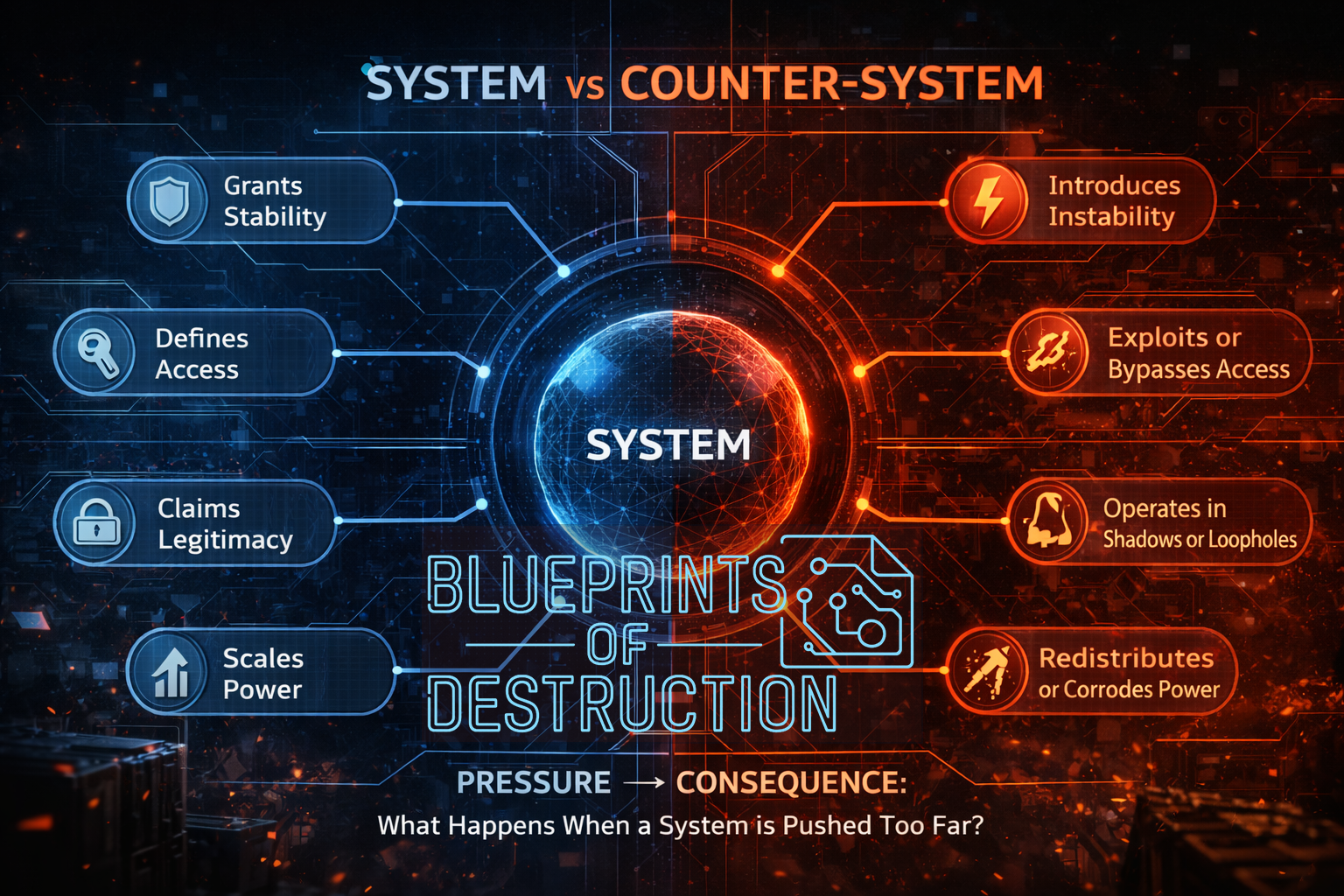
Instead of your world fighting against a single "bad" concept or individual, the story is allowed to ask: What happens when a system is pushed too far?
Types of Counter-Systems
In Qualx, there are three major dissenting systems:
- The Mob
- The Pirates
- The Uprising
Each of these systems exist to oppose a section of the network the Hive has created.
In order to break down how each of these systems oppose the established system, we must first take a closer look at the specific pathways alternative systems take to create this opposition.
A system:
- Grants stability
- Defines access
- Claims legitimacy
- Scales power
A Counter-System:
- Introduces Instability
- Exploits or bypasses access
- Operates in shadows or loopholes
- Redistributes or corrodes power
Now, let's take a look at how three of the major counter systems on Qualx challenge established authority and create friction.
The Mob
The Mob is the direct counter to the disinterested fist of bureaucracy known as the Senate. Covered in red tape, and burdened by infighting and political strife, many can no longer rely on senators to function properly or be of any help.
To solve this problem, the Mob swooped in. Meting out both judgment and retribution, they traffic in violence, influence, and corruption. Operating with rigid hierarchy and silent loyalty, they exert territorial control, functioning like the Senate but with none of the red tape or burdensome morals.
While their practices can be seen as unconventional, and even violent by some, many of the sectors they control see them as local protectors and providers of justice. In their eyes, these are things the senate has forgotten how to do long ago.
Citizens and unwrits alike can take their grievances to the Mob to have them resolved, though the price that must be paid is higher than some might see as reasonable.
While the Mob functions to provide individuals with protection and revenge, that doesn't solve all of the problems faced. To have access to illicit goods and services, one need turn to the pirates.
The Pirates
A network of mobile traders who pride themselves on their lack of Life Rights, they are a web of black-market logistics specialists. Focusing goods, they offer both specialty and basic household goods.
Pirates revel in disrupting the Conglomerate's intricate transportation system, they upend the monopoly that the Conglomerate holds. Pirates supply smaller communities with stolen and smuggled goods and technology that is otherwise highly restricted.
More than their movement of goods, the pirates offer an alternative way of living. What they provide is the perception of freedom from what they think is oversight (from the Conglomerate and the Hive). They offer a way of life that appears to provide independence from suffocating surveillance, though they still have rigid hierarchies and even social safety nets.
This antiestablishment offering comes at a cost many individuals ultimately find is higher than they anticipated, and includes just as much oversight, if not more. One oversight is simply traded for another. With as much as the pirates provide, it all boils down to goods and transport.
If someone was looking to take up the cause against the muzh system, the Uprising is who will provide them with what they are looking for.
The Uprising
The Uprising formed as a response to the muzh system. Focusing on the "liberation" of the Muzh, they fight against what they view as a morally reprehensible system.
The Uprising does its best to interrupt labor supply through the removal of assets from circulation. Focusing on the individual, rather than the whole, they attempt to shake the system at its base.
The Uprising offers an alternative to muzh forced into servitude. Yet, they are the most incendiary counter-system of the three.
Some tolerate them because they agree with their motives, while others view them as a pawn to position in a larger political game. Still others abhor their seeming lack of morals and the drastic lengths they are willing to go.
One thing is certain: each side can agree that rather than bringing those with differing views together, they have only succeeded in driving those very same individuals further apart. Rather than bringing the system down, their actions have most often resulted in inciting the Conglomerate to exercise still more control over the general populace.
Create a World Through Conflict and Rebellion
Each one of these systems, the Mob, the Pirates, and the Uprising, are specific and direct answers to the systems established by the Hive. Every alternative system answers the strict, authoritarian, pre-established system with conflict.
But each system is successful because it fills a gap in the wider mechanics of the world that helps citizens within Qualx. Each answers a call to action that the Conglomerate has seemed to turn a deaf ear to.
How can you improve your world with conflict and rebellion? Does your world have forms of dissent? Are there underground movements, rival factions, or sanctioned opposition against the primary system of your world?
Power is not always easy to see. When you follow power, you begin to see how your world truly works. You see who decides things, who enforces them, and who cannot be ignored.
Once you know where the consequences come from, the rest of the world falls into place.
Power shapes the rules.
The rules shape the world.
And the world shapes your story.
You might realize that writing your story is more about discovery than creation. Take your time as you dig and unearth your story. Ask your questions and build your world one answer at a time.
