Life Rights Acquisition
In Qualx, Life Rights are the legal proof that a being exists inside the system. More than simple citizenship, they grant recognition, protection, and the ability to participate in society.
Without Life Rights, an individual is not merely a criminal or exile. They are something far worse: legally unrecognized.
An individual without Life Rights has no standing in the system. They cannot enter contracts, access services, or claim protection under the law. They have no account with the Conglomerate, so they cannot legally conduct business. To the Conglomerate, they simply do not exist.

Life Rights have become one of the most valuable commodities in Qualx because they determine whether a being can participate in society. They can be traded, used as collateral, or exchanged through legal agreements. When Life Rights change ownership, therefore, the consequences can be severe.
One of the most controversial mechanisms of the system of Life Rights is known as the Acquisition of Life Rights.
What is a Life Rights Acquisition?
Acquisition of Life Rights occurs when the legal owner of a set of Life Rights chooses to retrieve the being connected to those rights. Once a being no longer owns their Life Rights, they are no longer protected by the system that once recognized them as a citizen.
This situation typically arises after Life Rights have transferred ownership through:
- Debt agreements
- Contracts
- Voluntary exchange
- Criminal penalties
Once a being relinquishes their Life Rights, the person who acquires those rights gains access to the legal grey area in which the individual now exists. At this point, the now former citizen becomes something unsettling within the Conglomerate system: neither citizen, nor unwrit. They are in limbo until the owner of the Life Rights decides what to do with them.
If the new owner chooses to reclaim their Life Rights, they may initiate a formal process that allows the individual to be retrieved or eliminated.

The Technology Behind Life Rights
Access to Life Rights is granted through a small technological device known as a LifeLink.
This is a plate, and is usually installed in the left forearm of a bipedal species. For species with different body structures, the plate may be installed in the left foreleg, dominant tentacle, or other equivalent primary appendage.
The LifeLink performs several primary functions:
- Identity Verification
- Legal Authentication
- System Access
- Proof of Citizenship
The LifeLink device connects the individual to the Conglomerate's vast administrative network, ensuring that their legal status can be verified anywhere in the system.
If an individual loses their Life Rights, the plate itself may remain physically present. However, its legal authority becomes void and the LifeLink is deactivated.
The new owner of the Life Rights may choose to remove the plate entirely. This is not required for legal possession, but some owners do so as a demonstration of dominance. Removing the plate is considered one of the most humiliating displays in Qualxian society.
Its removal sends a clear message:
This individual is no longer protected.
Hiring an Acquisition Contractor
The system strongly discourages unsanctioned pursuit. There are many procedural steps that need to be taken, and if done incorrectly, could result in undesirable legal challenges.
To begin an acquisition request, the Life Rights holder must submit an official application within the Synaplex, the official system registry and database.
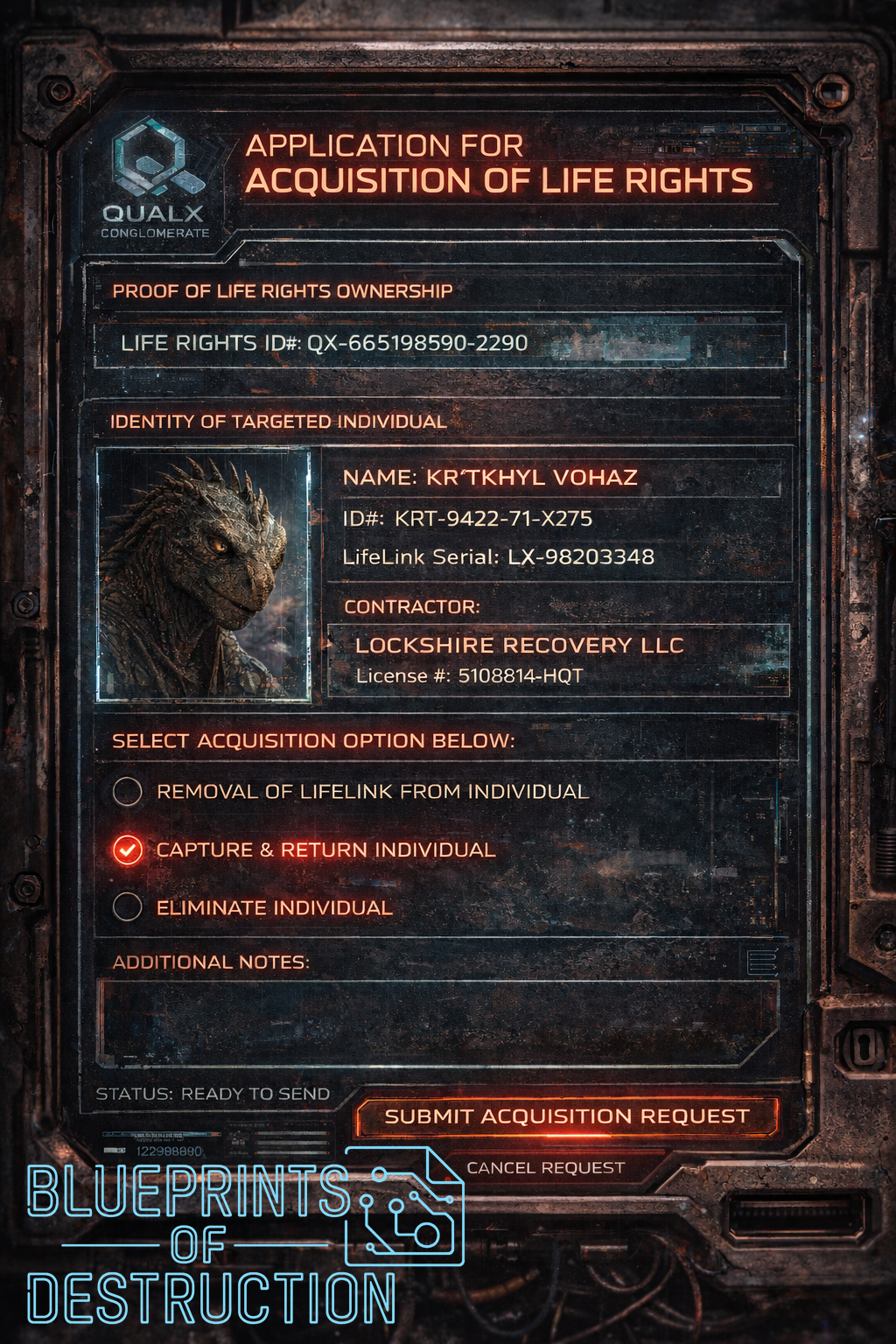
The application includes:
- Proof of Life Rights ownership
- The identity of the individual tied to the rights
- The name of the licensed contractor
Once submitted, the Conglomerate reviews the request to verify its legality. If approved, the contractor receives official authorization to carry out the acquisition. Once authorized, the contractor may proceed with one of three outcomes:
- Remove the LifeLink and deliver it to the owner
- Capture the individual and return them to the Life Rights holder
- Eliminate the individual
Any of these outcomes are legal under the system, provided the authorization process was properly followed.
Removing the LifeLink is not the action that reclaims the Life Rights. That is done through the Synaplex system. It is merely a symbolic action the current Life Rights holder may choose to take.
The Role of Contractors
Acquisition contractors occupy a strange place in Qualx society. They operate as independent agents who perform a function most citizens prefer not to even think about. In practice, they are compared to bounty hunters, assassins, or hitmen.
However, within the Conglomerate system, they are simply licensed professionals performing a regulated and mundane task.
Contractors must maintain valid licensing through the Conglomerate registry. If a contractor acts on a properly authorized request, they bear no legal responsibility for the outcome.
However, the system draws a sharp line between legal and illegal acquisition.
Illegal Acquisition and Punishment
Illegal acquisition happens when an individual forges the possession of another's Life Rights. They then submit the false information through the system, and secure approval for an authorized contractor to take the acquisition job. If an individual issues an unauthorized contract for termination, and they are discovered by the Conglomerate, the same penalties apply.
If an authorized contractor acquires the wrong individual or device, heavy penalties may also apply. However, certain benefits are included when an individual is licensed through the Conglomerate, so repercussions are usually less severe. (Think of a repossession company taking possession of a vehicle that matched the description, but might have the wrong license plate or which had no plate at all.)
The Conglomerate enforces acquisition procedures with strict penalties. If an individual attempts to reclaim Life Rights through illegal means, the consequences are immediate and dynamic.

The person who initiated the illegal acquisition loses their own Life Rights. This punishment is severe but effective. By tying enforcement directly to Life Rights status, the Conglomerate discourages unauthorized violence while maintaining total control over the process.
Contractors, however, are treated differently.
As long as a contractor is licensed and reasonably believes that the acquisition request was legal, they are not held responsible for participating. Only if it can be proven that the contractor knowingly assisted in an illegal acquisition will penalties apply. In this way, the system is able to protect the contractors who keep the machinery of Life Rights functioning.
Why the Conglomerate Created Life Rights
At first glance, Life Rights as a system appears cruel. But the Conglomerate did not create it out of malice.
The architects of the system believe that scarcity drives purpose and ambition. They argue that if every being were guaranteed permanent citizenship, society would stagnate. Without the possibility of losing one's place in the system, ambition would fade. On top of that, even citizens still consume other beings from other species. The system of Life Rights was also a way to determine which individuals could be eaten without ramifications.
By making Life Rights a finite and transferable resource, the Conglomerate ensures that every citizen has something to strive for. Individuals work harder to protect what they might lose as they compete for status, security, and recognition within the system.
To the Conglomerate, this is not oppression. It is efficiency.
The Experience of Loss
On paper, the process of Life Rights Acquisition appears clean and orderly. Forms are filed. Licenses are verified. Approval is granted.
Everything is legal.
Everything is documented.
Everything follows protocol.
To the conglomerate, it is simply another administrative procedure. But for the one whose Life Rights are being acquired it is anything but orderly.

The moment their Life Rights are lost, they become invisible. No protection. No citizenship. No voice. From that moment, the machine begins to move. Somewhere in the vast bureaucracy of the Conglomerate, a stamp of approval is issued. A contractor receives authorization to bring them in.
...or to end them.
And within the Conglomerate's system of order, ambition, and efficiency, one truth remains:
Once the gears of procedure begin to turn, it is impossible to stop them. Existence is conditional.
To fully understand this system, it helps to explore the broader structure of the World of Qualx, where Life Rights shape nearly every aspect of society.
Life Rights Related Pages:
How to Write Better Stories with Complex Systems
Build Your Own World by Expanding Complex Systems
How to World Build Through Lore
Exploring What is World Building With Tiers and Rights
Make Your Own World by Breaking Concepts Down
Using Worldbuilding Ideas to Create Intricate Systems
Creating an Imperfect System with Tips for Worldbuilding
Building Worlds With Consequences
How Life Rights can be Acquisitioned
