Questions for a Story
Fifteen Core Questions of Qualx (Collapsible)
Fifteen Core Questions of Qualx (Collapsible)
Structural and Foundational Questions
1. Founding Principle: What was the original purpose or event that led to the formation of Qualx's governing body?
2. Power Source: Who or what grants authority in Qualx? Is authority granted by the people, an inherited class, or divine mandate?
3. Political Hierarchy: Does Qualx have a single central government, or multiple autonomous city-states that operate under one banner?
4. Guilds and Governance: How does the Guild function within the overall government structure? What groups, arms of government, organizations, corporate entities, or separate power blocs interact? Who negotiates with whom?
5. Citizenship and Life Rights: How are Life Rights granted, suspended, revoked, or used as currency? And who has the authority to execute and activate these transactions?
Administrative and Legal Questions
6. Law Enforcement: Who enforces law and order in Qualx? Is it a police-like structure, a military force, mindless automatons, Guild-appointed agents, or is there something darker and more mysterious at play?
7. Judicial System: Who administers justice? Are there trials, arbitration councils, judges, natural disasters sent by gods, or Guild tribunals?
8. Economic Control: What serves as currency in Qualx? And is the economy state-run, Guild-driven, capitalist, resource-based, or is it some kind of hybrid system?
9. Territorial Management: How is land and resource distribution managed? Is there private ownership, state assignments, or a link between Life Rights and the acquisition of raw materials?
Cultural and Ideological Questions
10. Core Ideology: What is the prevailing philosophy or moral compass of the government or people? What mindset helps determine order, progress, control, or survival?
11. Religion and Power: Does religion have any role in Qualx? If so, is it used to legitimize or challenge authority?
12. Information Control: How is knowledge and communication regulated? Is it open and free, heavily censored, or filtered through some kind of in-story gatekeeper or censor?
Political Dynamics
13. Conflict and Rebellion: What forms of dissent exist? Are there underground movements, rival factions, sanctioned opposition, or is it a free-for-all?
14. Military Role: If there is an army? Is it a protector of the people, an enforcer of the regime, or is it fragmented and bureaucratically useless?
15. Foreign Relations: Does Qualx interact with other peoples, nations, or worlds, or is it isolated and self-contained?
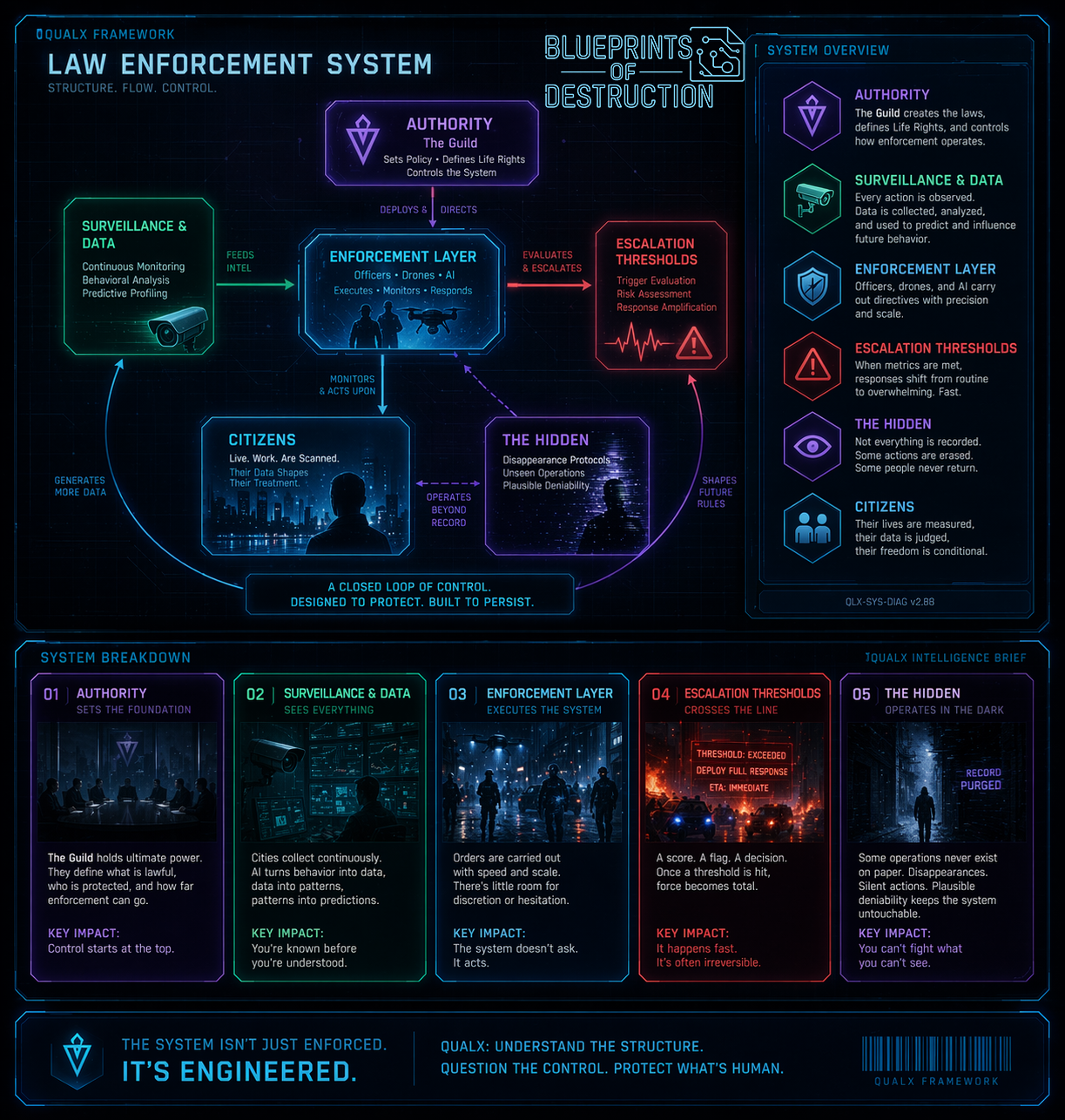
There are some questions for a story that you can ask yourself that will greatly improve the quality of your worldbuilding and storytelling. Let's focus on one element: Who enforces law and order on your world? Is it a police-like structure, the military, or autonomous drones?
Before we answer these questions in a Qualx-specific light, it may be more helpful to break down these questions into functional layers. These layers can then be applied to the world that you are creating.
These questions for a story are not meant to be answered exhaustively on the page or directly within your storytelling. They are meant to be understood by you, as the author, so you can better translate your world onto the page.
1. Function
Before naming who enforces law, it is important to clarify what enforcement is meant to accomplish.
- Is enforcement about order, obedience, fear, efficiency, or moral legitimacy?
- Is the goal to correct behavior, remove threats, or maintain systemic balance?
- Does law exist to protect citizens, or to protect the system from citizens?
This answer should describe why enforcement exists before discussing who carries it out.
The Guild, Qualx's law enforcement, serves many functions. Through a combination of military force and police authority, it enforces both order and obedience. Through fear and lawful legitimacy, the Guild enacts approved laws. Its job isn't to decide what is morally "correct," but to administer what has already been established by the bureaucracy and the Grand Archon.
The laws of Qualx exist to both protect the citizens of Qualx and support the movement of resources to the Hive. Through the removal of threats and the control of undesirable behavior, the Guild is able to keep the citizens safe, productive, and effective.
The Guild acts like a police-military hybrid because it is believed that the city is a single world-wide city. This means that the Conglomerate does not need two separate entities for the police and military. It needs a single system that can do both. The Guild manages the citizens within the city to keep the citizens law-abiding and safe while simultaneously acting as a military force against those individuals within Qualx who seek to harm or exploit the citizens.
2. Visible vs. True Authority
In order to define who looks like they have authority, and who actually has authority, it is important to establish a few things:
- Who do citizens believe enforces the law?
- Who practically has final enforcement power?
- Who benefits from the outcomes of enforcement?
The answers to these questions can be the same entity, or layered ones. Perhaps some outcomes might be deliberately obscured from the citizens of your world. Enforcement on your world doesn't need to be straightforward, as long as you the creator have a clear understanding about it.
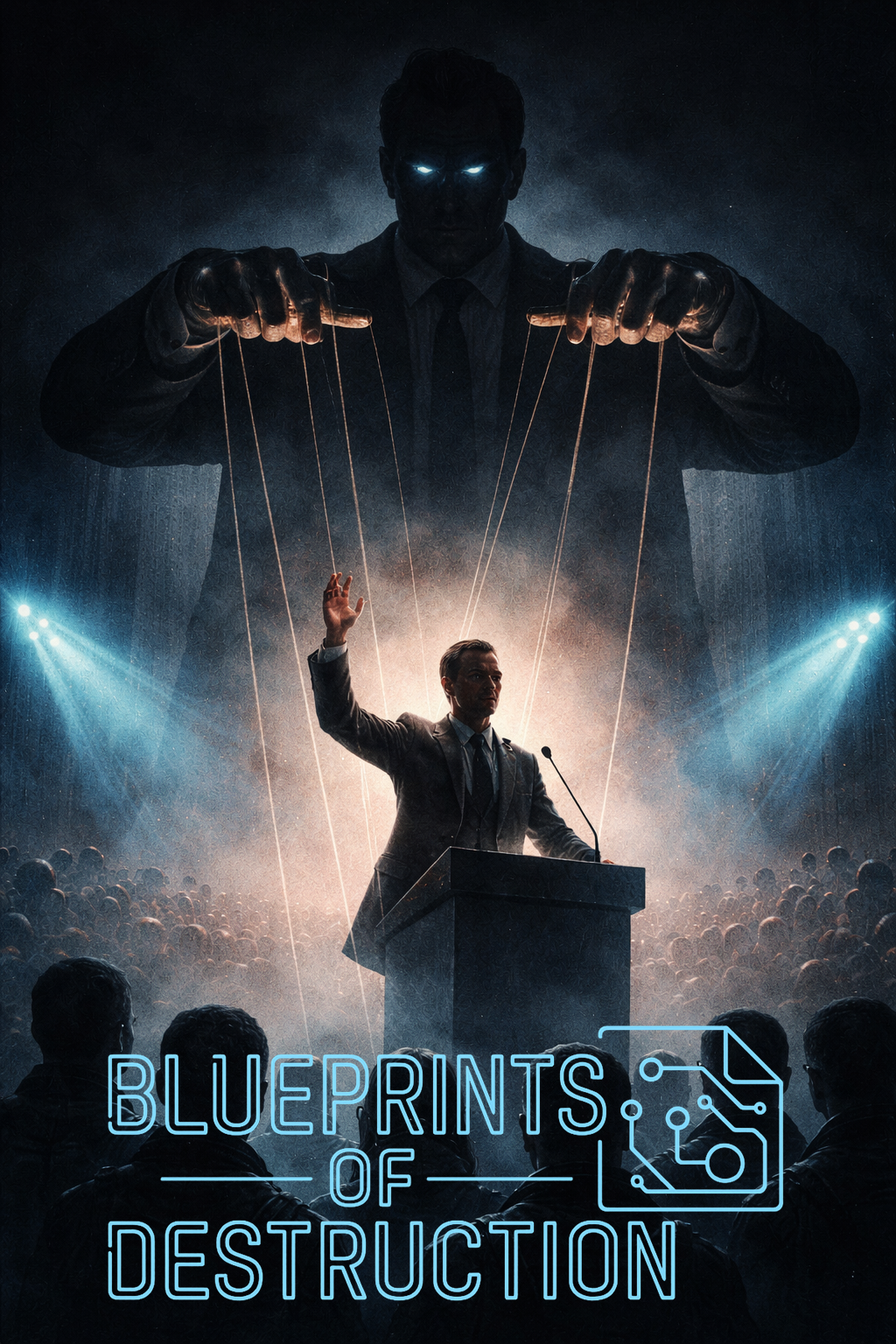
Some of the most powerful answers involve a misalignment of perception and reality.
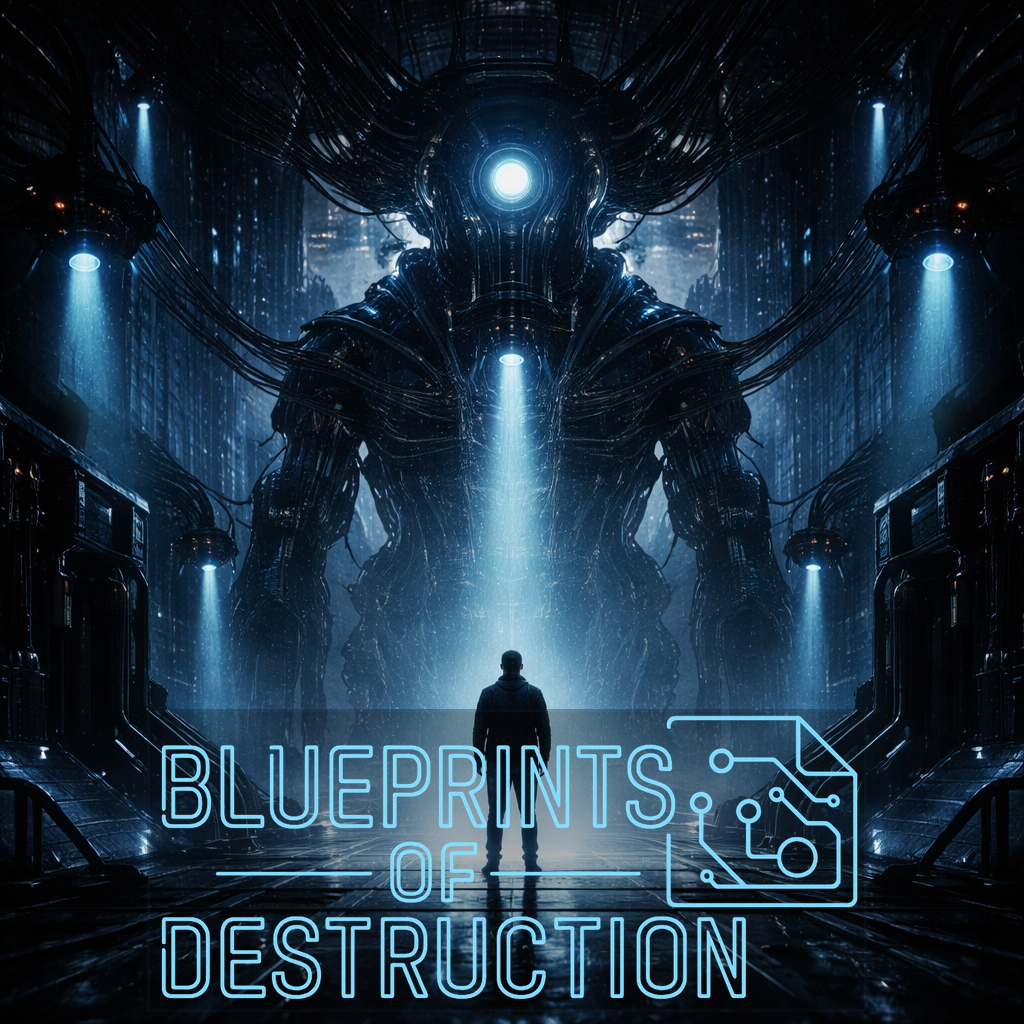
The citizens of Qualx are under no illusion of who controls the city and enforces laws. They understand that the Guild enforces laws, but that the Grand Archon holds the ultimate and final authority. The greater whole benefits from the outcomes of law enforcement, which help ensure that citizens can live in a largely safe environment as they continue their lives.
3. Temporal Enforcement
- Does enforcement respond before or after crimes occur?
- Are punishments public and demonstrative, or are they silent?
These answers will shape the tone of your world immediately and can determine whether your world feels authoritarian, eerily calm, or serene.
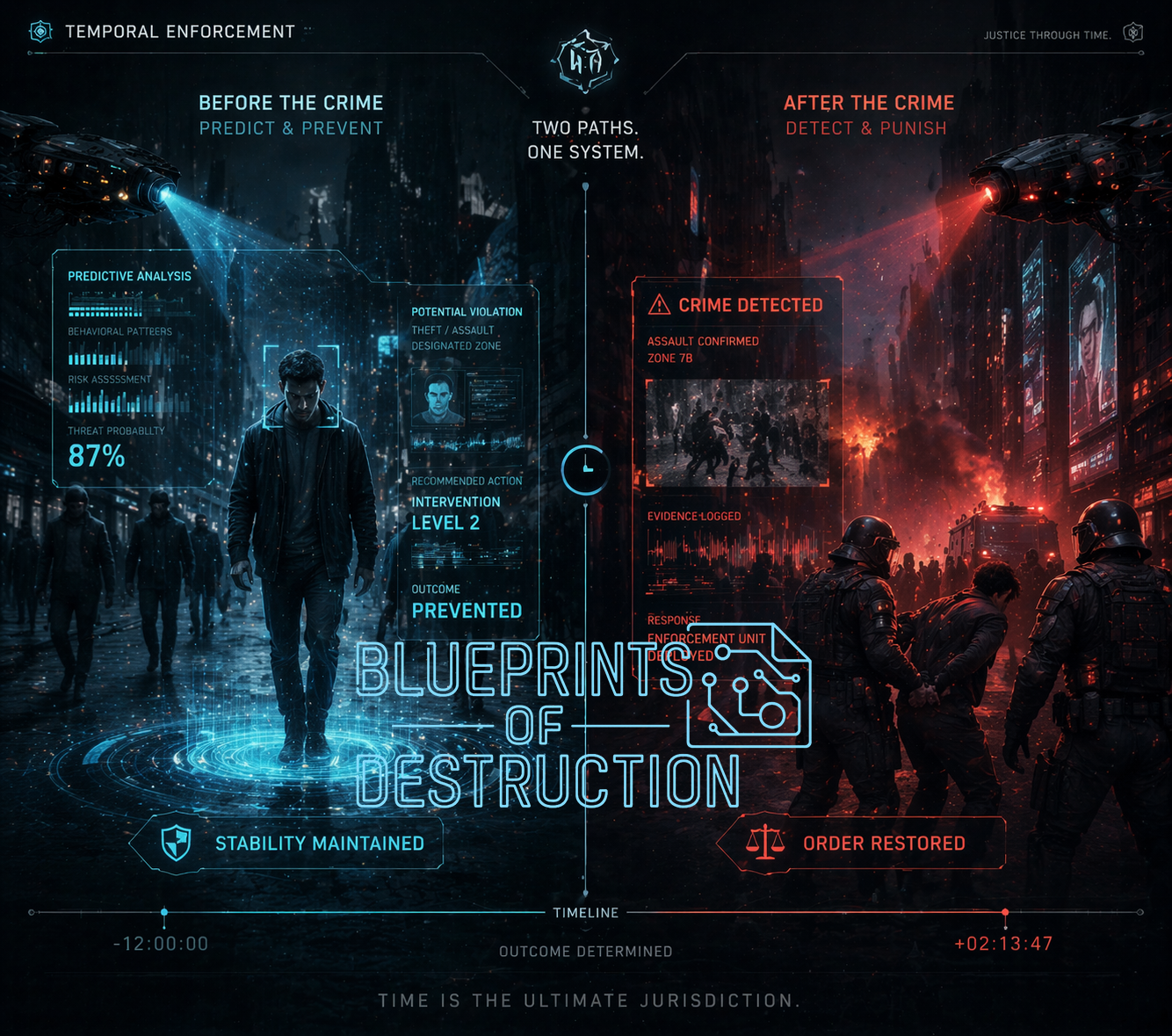
The Guild functions as both a reactive and preemptive force. In many cases, Guild agents arrive only after a crime has already occurred. However, because Qualx uses a vast and all-encompassing data system, the Guild is able to closely monitor potential threats. While this system is effective, it is not perfect and cannot catch every issue.
Punishments are largely public. When a crime of sufficient severity is committed and a citizen is demoted to vozh status, it is a highly visible occasion. Vozh status includes bright clothing meant to warn others of potentially violent offenders, though not all vozh are violent.
Silent punishment does occur, but is extremely rare. These "disappearances" are mostly limited to offending Guildsmen, who exist within a separate system from most citizens who hold Life Rights.
4. Distance
- How close is law enforcement to the citizens?
There are many answers to this question that span an entire spectrum.
Are the law enforcement personnel pulled directly from the pool of citizens? Are they augmented citizens? Are they automatons? Is the law enforcement on your world more abstract, where a system without a face decides the outcome of offending citizens?
To further clarify this system you can ask yourself:
- Can enforcement hesitate?
- Can it show mercy?
- Can it be reasoned with?
The less human the system of law enforcement, the more critical the threat becomes.
Members of the Guild are drawn directly from the citizens of Qualx. While many agents are augmented, this is largely because prosthetics and augmentation are common throughout the city.
Guild agents are capable of hesitation and mercy, but acting against orders carries severe consequences. While the Guild does experience rare "human" moments, these acts often come at a great personal cost and are therefore uncommon.
5. Uniform or Stratified
Is the law enforcement on your world applied equally, or does it reinforce themes of control or exemption? Is there disparity in the way the law is applied?
- Do different cities, castes, or zones experience different enforcement styles?
- Are some citizens above enforcement?
- Are punishments consistent or situational?
Since Qualx is a single city, there is little variation in how the law is applied or executed.
Archons, while technically subject to the law, are all but untouchable. The offense would need to be severe for any action to be taken.
The Grand Archon however, is the law. According to Qualxian law, he can do no wrong, as he is the ultimate interpreter of justice. While the Grand Archon may face the wrath of the Hive, he cannot be judged by the city he rules. Since the citizens of Qualx have no knowledge of the Hive, there is effectively no higher authority to which the citizens may appeal.
6. The Hidden
Are there implications in your world's system of law enforcement that allows for a shadowy, feared element to operate below the surface? While this does not need to be expressly stated in the storytelling of your writing, it is a good idea for you to know the answer.
- Are there disappearances instead of arrests?
- Do enforcement mechanisms that no one acknowledges exist?
- Are there consequences without visible cause?
While law enforcement on Qualx is usually as direct as it is public, a much darker side exists. This hidden side is the Guild's sister operation, the Vitalis Directorate. The Directorate, which includes everything from research and information gathering to medical care and technological development, are an open secret.
The most dangerous criminal offenders are sent here, often to their deaths, under the thin veil of "research."
7. Escalation Thresholds
What happens when enforcement fails?
- What violations trigger routine enforcement or extraordinary response?
- Who decides when escalation occurs?
- Is escalation reversible or final?
In Qualx, enforcement does not fail in the traditional sense. When resistance arises, whether from criminal syndicates or ideological uprisings, the Guild evaluates how continued enforcement would affect the overall system's stability. Larger threats that endanger order or safety may trigger stronger responses. These decisions are not made by a single individual, but through Guild rules, limits, and predictive systems.
Routine actions are reversible; extraordinary responses are not. Final escalation does not always mean destruction. Often, it means exclusion or containment.
Together, these answers show how the Guild operates as a part of everyday life in Qualx. Law is not just about stopping crime, it is about keeping the city running and stable. As a story develops, worlds such as Qualx are given the space to feel more real and believable.
These questions, and the example of the Guild from the world of Blueprints of Destruction, help show that answers do not need to be perfect or final. They are tools meant to help guide thinking and spark ideas. By understanding systems such as law enforcement, you can create stronger conflicts and more meaningful choices for your characters. The clearer the rules of a world are, the more powerful its stories can become!
Defining how the laws are enforced within your story can help shape how enforcement as a system can bleed into your narrative's tension.
Questions for a story define the way that the characters experience the world. It isn't just about the laws within the story, but about the consequences of the laws. The way that law enforcement on your world functions defines safety, obedience, and the daily norm.
Strong worlds are build on top of solid systems. Law, power, and control all work together to shape how people live. These systems decide who is safe, who is watched, and who is not. The lives of every citizen is shaped by these ideas. These questions are tools that you can use in any story, and each shows one of the many ways in which your own story can come to life.
All you need to do is to ignite an idea, then sit down and start writing.
Interested in seeing the process that happens after the Guild takes action? Once the Guild has executed their function, the gears of the Judicial system begin to turn.
