How to Build Authority Systems for Worldbuilding
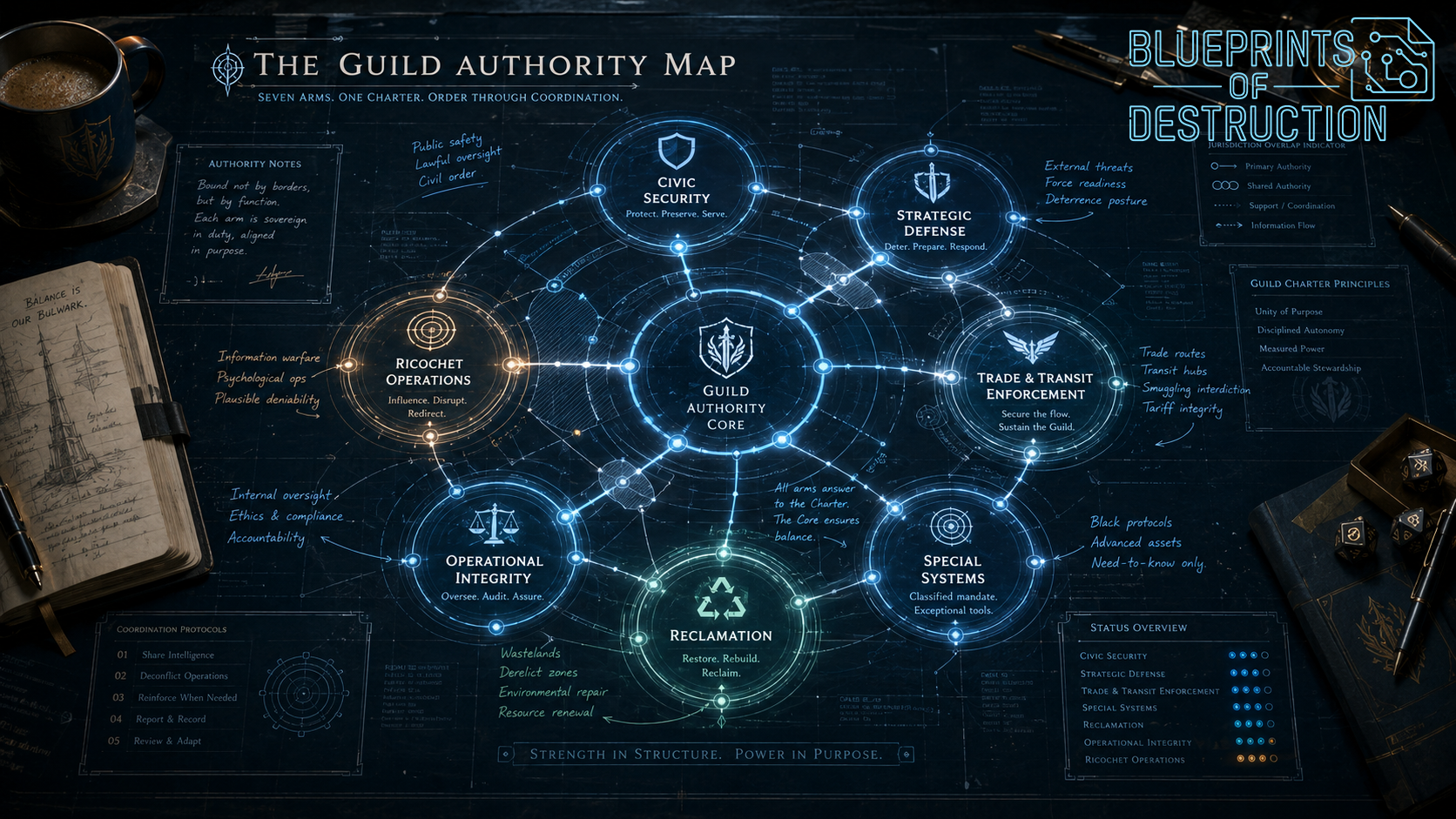
Fifteen Core Questions of Qualx (Collapsible)
Fifteen Core Questions of Qualx (Collapsible)
Structural and Foundational Questions
1. Founding Principle: What was the original purpose or event that led to the formation of Qualx's governing body?
2. Power Source: Who or what grants authority in Qualx? Is authority granted by the people, an inherited class, or divine mandate?
3. Political Hierarchy: Does Qualx have a single central government, or multiple autonomous city-states that operate under one banner?
4. Guilds and Governance: How does the Guild function within the overall government structure? What groups, arms of government, organizations, corporate entities, or separate power blocs interact? Who negotiates with whom?
5. Citizenship and Life Rights: How are Life Rights granted, suspended, revoked, or used as currency? And who has the authority to execute and activate these transactions?
Administrative and Legal Questions
6. Law Enforcement: Who enforces law and order in Qualx? Is it a police-like structure, a military force, mindless automatons, Guild-appointed agents, or is there something darker and more mysterious at play?
7. Judicial System: Who administers justice? Are there trials, arbitration councils, judges, natural disasters sent by gods, or Guild tribunals?
8. Economic Control: What serves as currency in Qualx? And is the economy state-run, Guild-driven, capitalist, resource-based, or is it some kind of hybrid system?
9. Territorial Management: How is land and resource distribution managed? Is there private ownership, state assignments, or a link between Life Rights and the acquisition of raw materials?
Cultural and Ideological Questions
10. Core Ideology: What is the prevailing philosophy or moral compass of the government or people? What mindset helps determine order, progress, control, or survival?
11. Religion and Power: Does religion have any role in Qualx? If so, is it used to legitimize or challenge authority?
12. Information Control: How is knowledge and communication regulated? Is it open and free, heavily censored, or filtered through some kind of in-story gatekeeper or censor?
Political Dynamics
13. Conflict and Rebellion: What forms of dissent exist? Are there underground movements, rival factions, sanctioned opposition, or is it a free-for-all?
14. Military Role: If there is an army? Is it a protector of the people, an enforcer of the regime, or is it fragmented and bureaucratically useless?
15. Foreign Relations: Does Qualx interact with other peoples, nations, or worlds, or is it isolated and self-contained?
Within Qualx, the Guild does not maintain a single unified military in the traditional sense. Instead, authority is divided across five operational arms, each responsible for protecting a different pillar of one of the systems that keeps Qualx functioning. A sixth division, Ricochet Operations, functions across all jurisdictions. This is efficient, but these arms frequently overlap in responsibility, and disputes over jurisdiction are not uncommon.
Civic Security Arm
Go back up to the Guild Authority Map
Primary Function: The protection of citizens and infrastructure.
This is the part of the Guild most visible to everyday citizens. Civic Security operates across transit hubs, residential districts, and market zones.
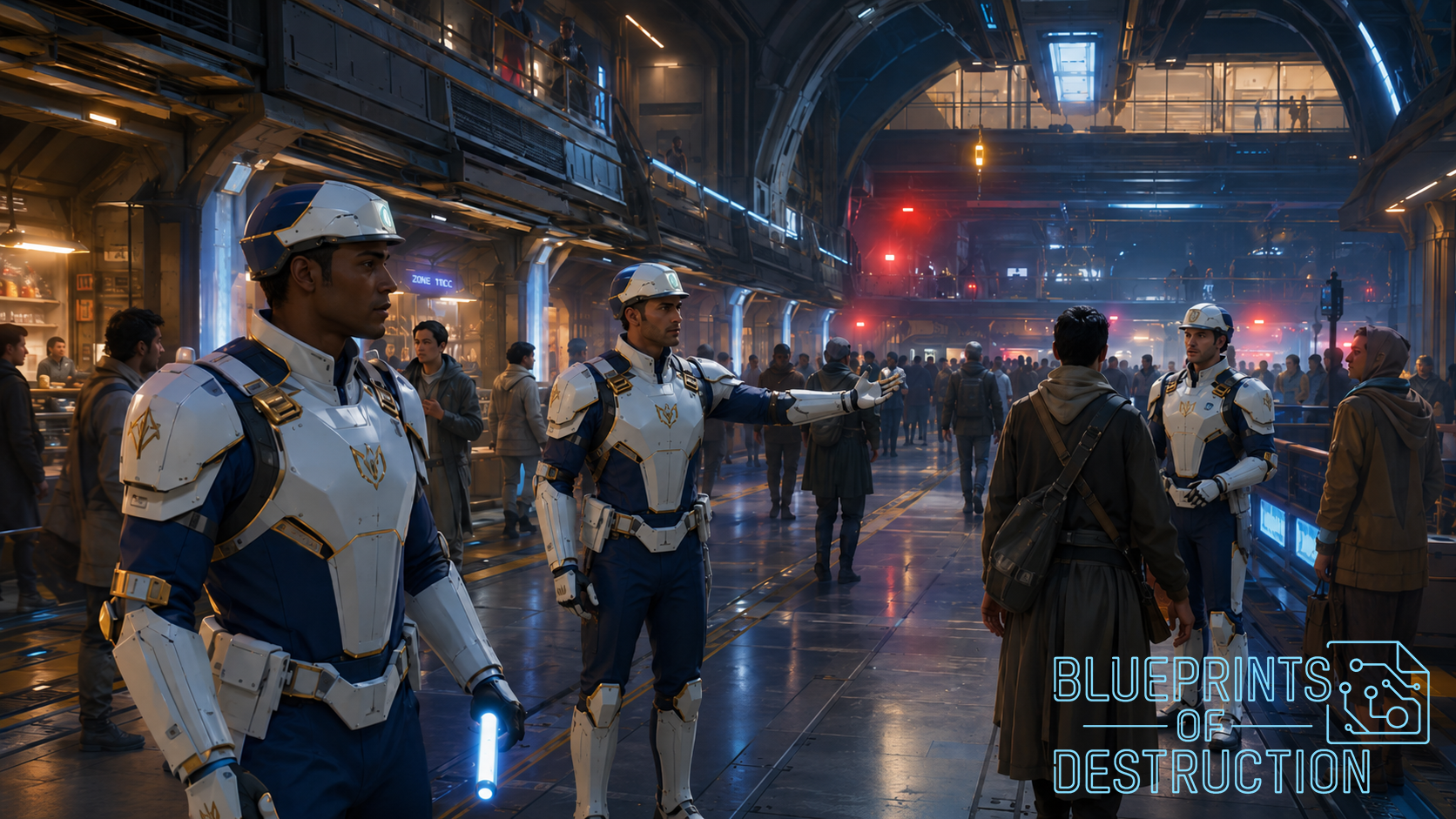
Their responsibilities include:
- Protecting civilian populations
- Securing entry points into transportation systems
- Assisting other arms in emergencies
- Responding to localized threats
Their role centers on public security and stabilization. Citizens generally view Civic Security as protectors, though ultimately they fall under the same banner as the rest of the Guild.
Strategic Defense Arm
Go back up to the Guild Authority Map
Primary Function: The defense of Qualx
Strategic Defense is responsible for large-scale threats that could endanger entire sectors or subsectors, or pose a threat to large swaths of the population. Because Qualx is viewed as a world-wide city by the citizens, there are no outside threat considerations, only organized internal ones.
Their responsibilities include:
- Large-scale military response
- Defense against organized threats
- Protection of critical Guild assets
- Maintaining strategic deterrence
Unlike Civic Security, these forces are rarely seen by civilians unless something is about to go (or has gone) very wrong. Their presence alone is a signal that a situation has escalated far beyond normal jurisdiction.
Trade and Transit Enforcement Arm
Go back up to the Guild Authority Map
Primary Function: Protection of commerce and movement
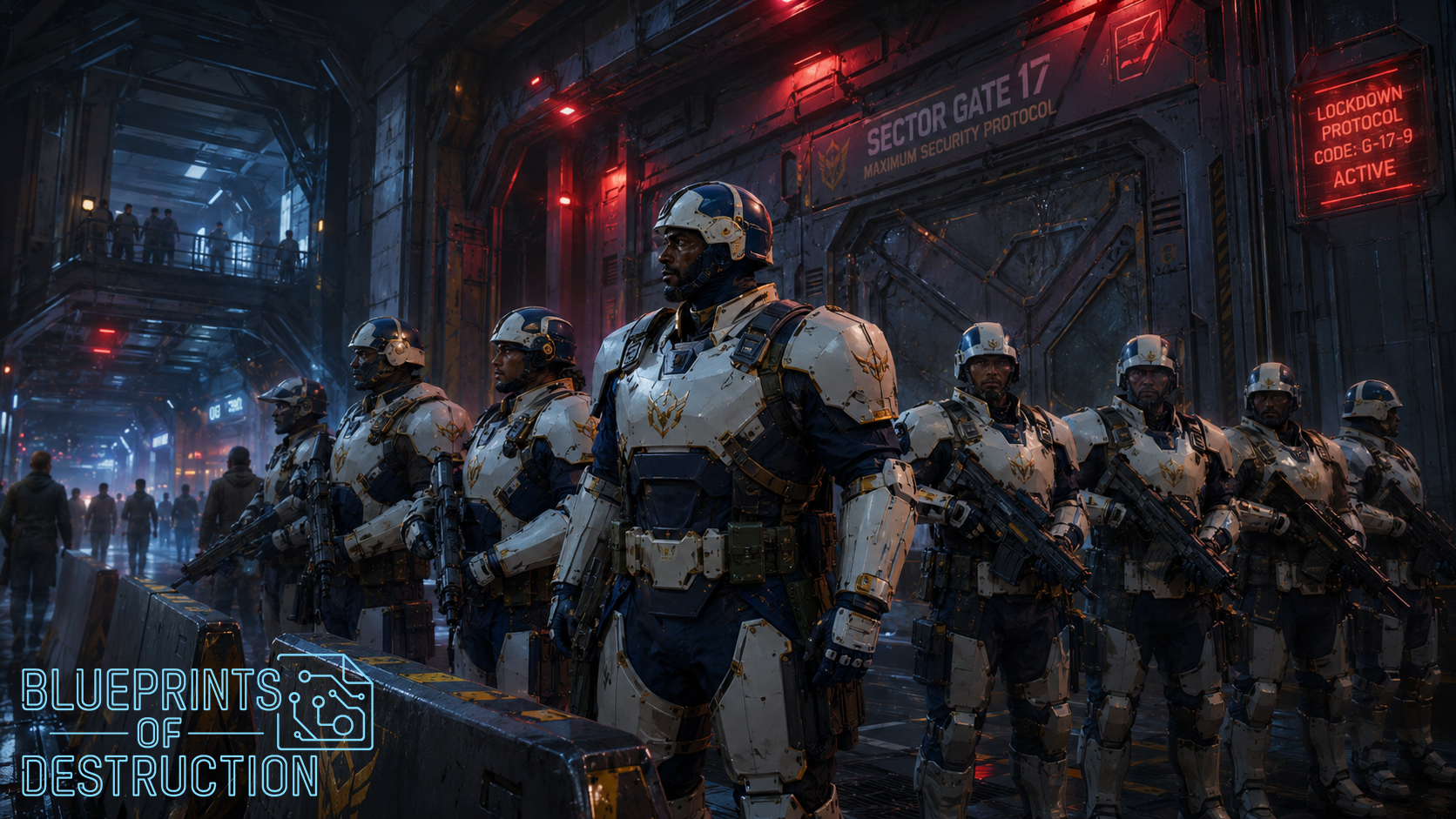
Because trade and transportation are the lifeblood of Qualx, the Guild maintains a dedicated force responsible for securing them.
This arm oversees:
- Shipping corridors
- Transit arcs and sliders
- Cargo ports and freight stations
- Anti-smuggling operations
- Piracy investigations
- Contraband enforcement
Trade Enforcement forces are known for being methodical and relentless, as disruptions to commerce can ripple across the entire system.
This arm frequently clashes with pirate groups and occasional unwrit networks.
Special Systems Arm
Go back up to the Guild Authority Map
Primary Function: The protection of sensitive Guild technologies and systems
Some threats cannot be handled by ordinary forces. The Special Systems Authority deals with events involving:
- Flicker anomalies
- Ricochet Pilot interdictions
- Experimental technologies
- Classified Guild research
These teams are highly specialized and are rarely deployed openly.
Citizens who encounter them often have a clear understanding that something extremely unusual has occurred. Their authority frequently overrides other Guild branches.
Reclamation Arm
Go back up to the Guild Authority Map
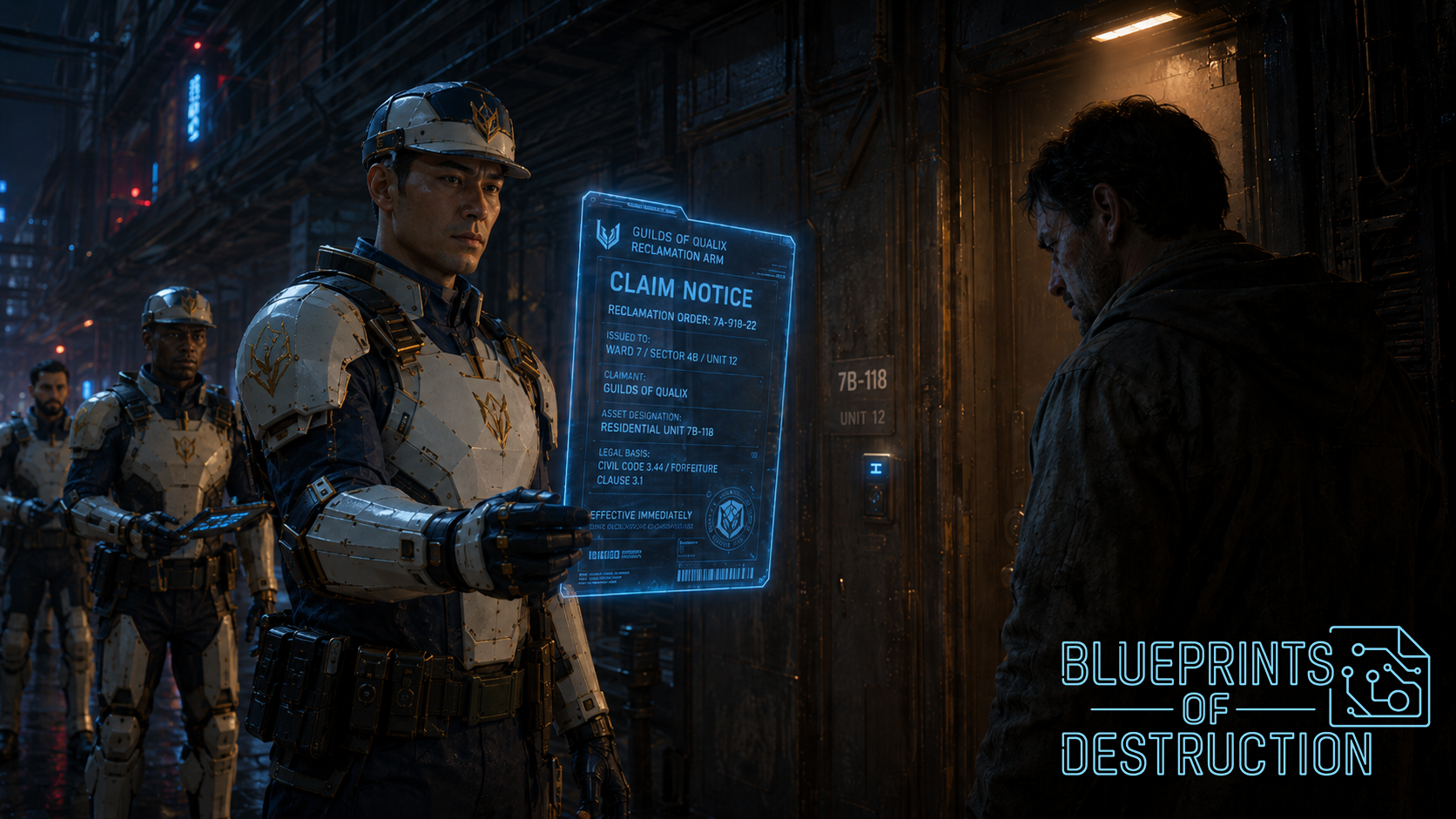
Primary Function: The retrieval of Guild assets and enforcement of contractual authority.
This arm operates in the gray space between military action and civilian contracting.
Their duties include:
- Life Rights reclamation
- Recovery of stolen Guild assets
- Contract enforcement
- Pursuit of fugitives
Unlike Civic Security, these operatives often function as independent contractors sanctioned by the Guild. This branch of the Guild is widely feared. Their involvement, while part of the legal process, can mean risk, even for those within legal bounds.
Operational Integrity Arm
Go back up to the Guild Authority Map
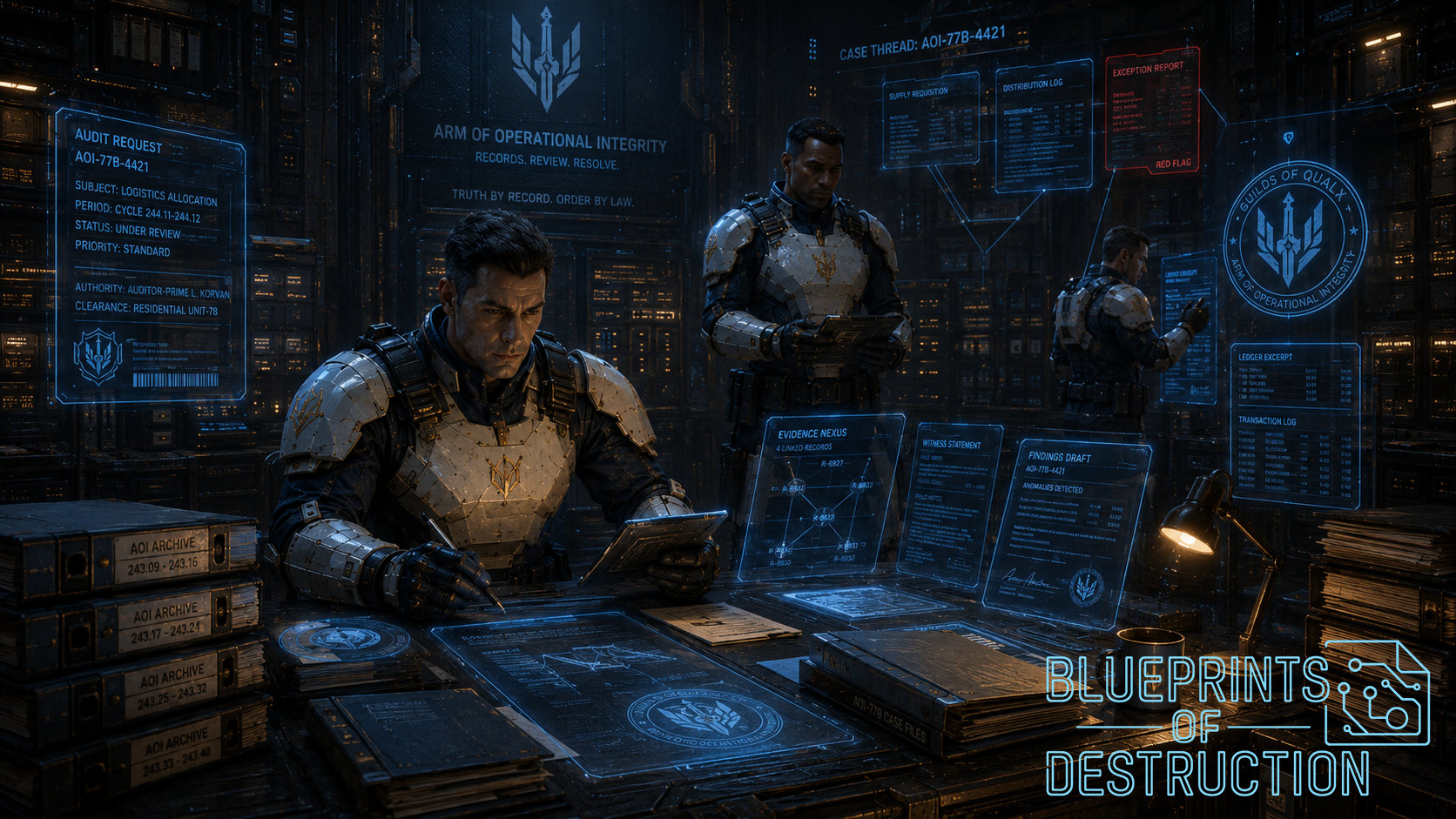
Primary Function: Ensure the proper function of the Guild
This arm investigates and maintains the integrity of each branch of the Guild. Even the Guild fears them. No one is above reproach, or investigation. If Operational Integrity finds your file on their desk, it is well understood that their decision is final.
Their duties include:
- Corruption investigations
- Discrepancies in official reports
- Inter-arm procedural violations
Ricochet Operations Division
Go back up to the Guild Authority Map
Unlike the other operational arms, Ricochet Operations does not function as a traditional branch of the Guild's military structure. While most Guild forces operate through conventional means, there exists one division whose authority crosses nearly every jurisdiction in Qualx: Ricochet Operations.
Ricochet Pilots are modified individuals capable of navigating the Flicker, an extradimensional medium that allows rapid transit across vast distances. Their abilities make them invaluable to the Guild in situations where speed, secrecy, or precision are required.
Unlike conventional military units, Ricochet teams rarely function as standing forces. Instead, they are deployed when an event requires immediate response beyond normal physical limits. Typically Ricochet Pilots work very closely with Guild auditors from Operational Integrity.
Their responsibilities include:
- Emergency transport under extreme conditions
- Rapid deployment of Guild personnel
- High-risk infiltration and extraction
- Investigation of past events through Flicker observation
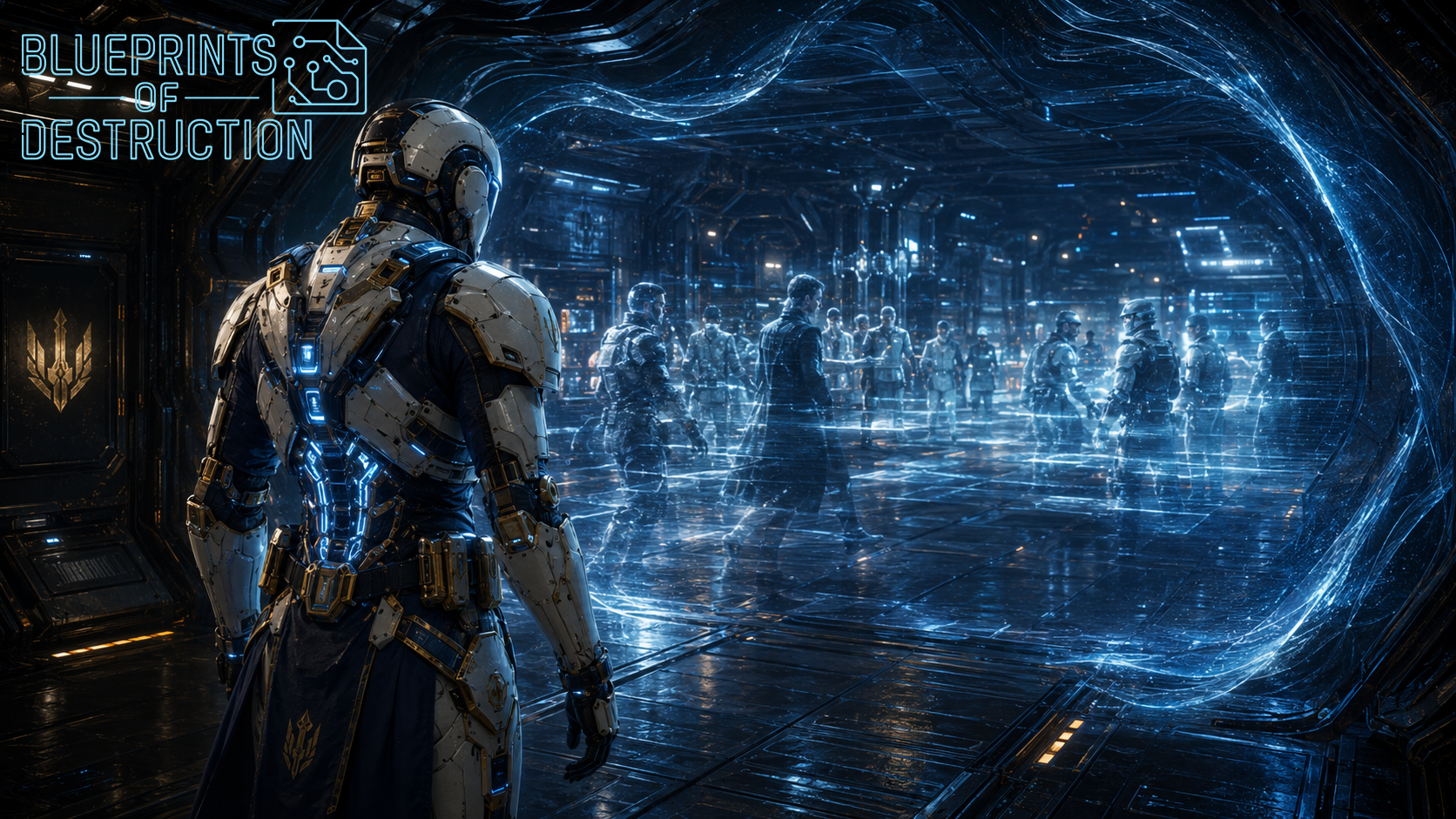
One of their most unusual capabilities is the ability to observe prior events by travelling along residual Flicker pathways tied to moments in time. While pilots can witness how an event unfolded, there is no known way for a pilot to interfere with or alter the past.
Because Ricochet Operations intersect with nearly every Guild authority, pilots may be temporarily assigned to assist Civic Security, Trade Enforcement, Special Systems units, or Reclamation teams. Occasionally, in the case of long-term specialized assignments, a Ricochet pilot may be assigned to a single Guild officer or team for extended periods.
In this way, Ricochet Pilots serve less as a branch of the military and more as a strategic tool that the Guild deploys wherever the system demands.
Jurisdictional Conflict
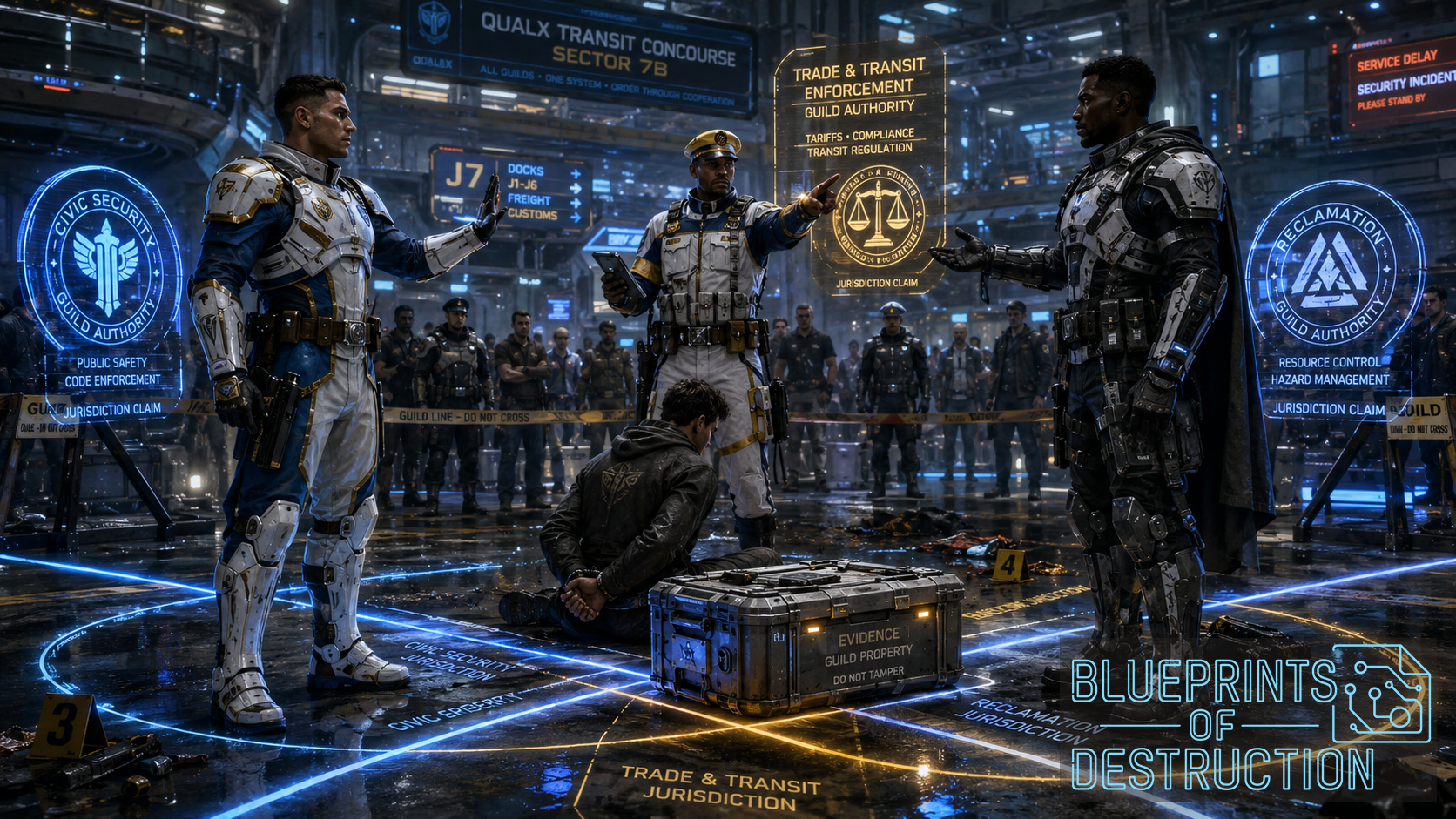
Because these operational arms protect different pillars of Qualx, their authority often overlaps.
For example:
- A piracy case may involve both Trade Enforcement and Reclamation Authority.
- A Flicker-related smuggling ring might involve Special Systems Authority and Trade Enforcement.
- A riot near a transit hub could draw both Civic Security and Strategic Defense.
When jurisdictions collide, the Guild must determine which authority has priority. These disputes can delay action, create political friction, or allow dangerous actors to slip through the cracks.
These conditions are fertile ground for conflict, tension, and narrative momentum.
How to Create a Guild-Style Power System in Your Own World
Complex worlds rarely operate under a single, simple authority. Instead, power is divided across specialized organizations, each responsible for maintaining a critical part of society. Instead of one military body or government controlling everything, power is divided into specialized groups that each maintain a different pillar of organization. When creating a fictional world, many writers struggle with designing governments, organizations, and authority systems.
A system like the Guild works because it organizes authority by responsibility, not by rank alone. It is important to note the discrepancies inherently found in the way the Guild's system is intentionally designed. Rather than viewing these as wrinkles that you, as the writer, need to iron out, view them as the deliberate infusion that creates pressure systems to further the plot and direction of the story.
If you are interested in developing a power system for your own world, check out the Power Systems Generator. This is a system that can help you design and develop structures like these. The goal is to help you create a believable network of authority that can give your world depth, conflict, and most importantly, realism.
Even complex systems, and the ideas that come from them, act as its very own process of randomization. While in some cases, it is okay to change prior ideas, for the most part, some of the best ideas come from having to work around pre-established complications.
Boxing in the narrative, provides you the opportunity to think outside the box. Having a central idea location (like Storystorm) is a good way to keep track of all the boxes you have already created. This will help make sure all your ideas stay consistent, and ensures you don't re-think ideas you have already established.
So grab your notebook (or document), jot down some ideas, and throw them into the context of your story! Perhaps if you think outside the box enough, your inner author will finally be able to step outside that box you have it trapped in!
