How to Build a World: The Founding Principle of Government
Fifteen Core Questions of Qualx (Collapsible)
Fifteen Core Questions of Qualx (Collapsible)
Structural and Foundational Questions
1. Founding Principle: What was the original purpose or event that led to the formation of Qualx's governing body?
2. Power Source: Who or what grants authority in Qualx? Is authority granted by the people, an inherited class, or divine mandate?
3. Political Hierarchy: Does Qualx have a single central government, or multiple autonomous city-states that operate under one banner?
4. Guilds and Governance: How does the Guild function within the overall government structure? What groups, arms of government, organizations, corporate entities, or separate power blocs interact? Who negotiates with whom?
5. Citizenship and Life Rights: How are Life Rights granted, suspended, revoked, or used as currency? And who has the authority to execute and activate these transactions?
Administrative and Legal Questions
6. Law Enforcement: Who enforces law and order in Qualx? Is it a police-like structure, a military force, mindless automatons, Guild-appointed agents, or is there something darker and more mysterious at play?
7. Judicial System: Who administers justice? Are there trials, arbitration councils, judges, natural disasters sent by gods, or Guild tribunals?
8. Economic Control: What serves as currency in Qualx? And is the economy state-run, Guild-driven, capitalist, resource-based, or is it some kind of hybrid system?
9. Territorial Management: How is land and resource distribution managed? Is there private ownership, state assignments, or a link between Life Rights and the acquisition of raw materials?
Cultural and Ideological Questions
10. Core Ideology: What is the prevailing philosophy or moral compass of the government or people? What mindset helps determine order, progress, control, or survival?
11. Religion and Power: Does religion have any role in Qualx? If so, is it used to legitimize or challenge authority?
12. Information Control: How is knowledge and communication regulated? Is it open and free, heavily censored, or filtered through some kind of in-story gatekeeper or censor?
Political Dynamics
13. Conflict and Rebellion: What forms of dissent exist? Are there underground movements, rival factions, sanctioned opposition, or is it a free-for-all?
14. Military Role: If there is an army? Is it a protector of the people, an enforcer of the regime, or is it fragmented and bureaucratically useless?
15. Foreign Relations: Does Qualx interact with other peoples, nations, or worlds, or is it isolated and self-contained?
Founding Principle: What was the original purpose or event that led to the formation of Qualx's governing body? Was it unification, rebellion, or natural evolution?
Qualx's governing body was not formed through true unification, rebellion, or natural evolution. It was manufactured.
The Quad-City was not built as a naturally developing civilization. It was created as a functioning machine whose job was to gather, process, organize, and send resources to the Hive. The governing body exists to keep that machine stable.
From the citizens' perspective, the governing structure of Qualx, the Conglomerate, appears ancient, legitimate, and even bordering on sacred. They believe it arose to unify competing species, prevent chaos, and preserve civic order.
That is the public-facing myth.
The Citizens' Understanding of the Foundation
Publicly, the citizens believe the Conglomerate was founded through unification. In truth, it was artificial design.
The formation of Qualx was not rebellion, because the system was not born from citizens rising up against previous authority. It was not natural evolution, because Qualxian society did not gradually develop its governing structure through regular historical pressure. It could not have truly been unification, because the citizens were not choosing to unite. They were created and organized into a controlled structure designed by forces they do not even understand exist.
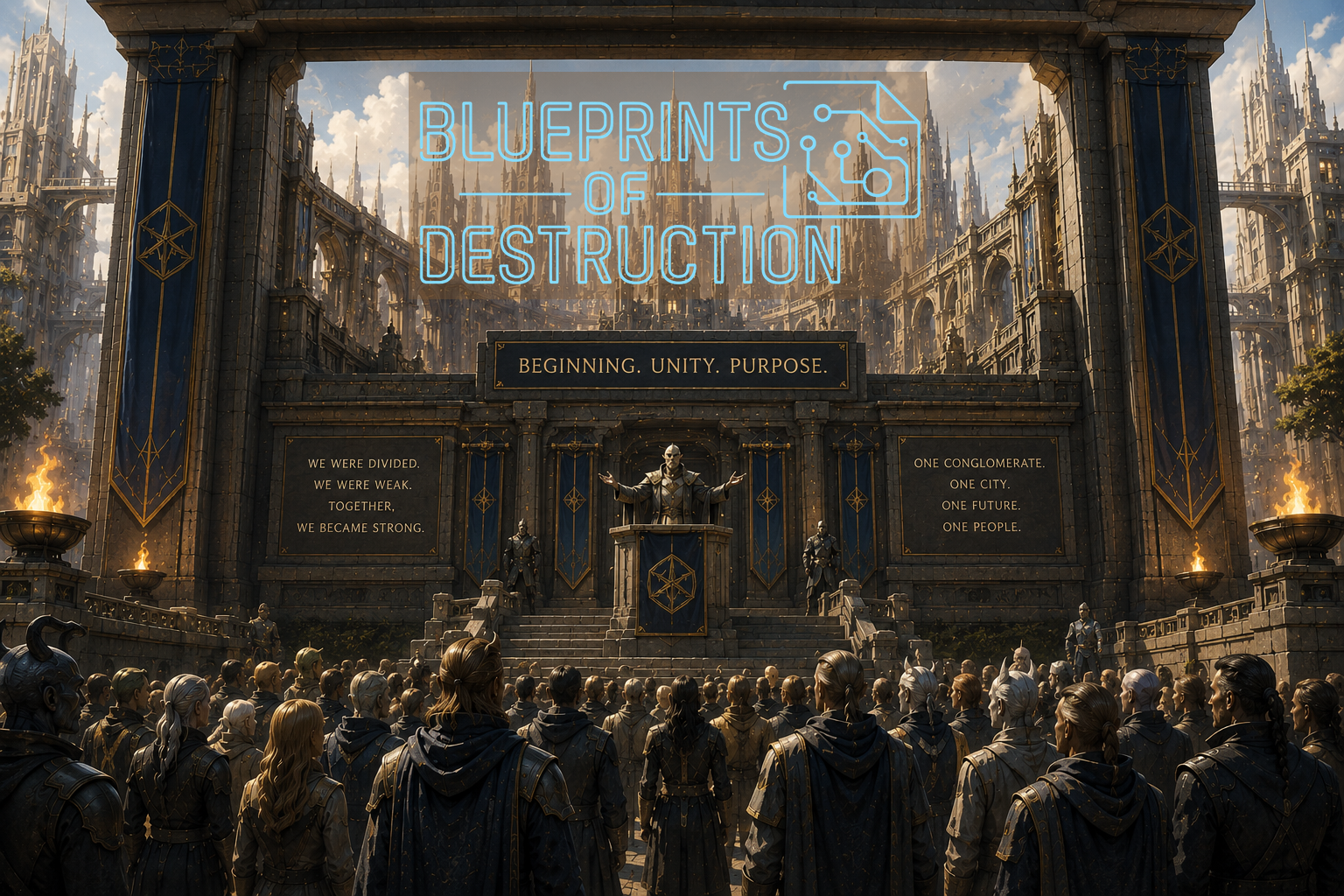
The citizens were taught that the Conglomerate was formed as a unifying authority: a system created to stabilize the Quad-City into a single, well-functioning machine that organized citizens and ensured a steady output of resources. From the citizens' perspective, the Conglomerate is the only reason the city functions in the first place.
Qualx's governing structure was created as part of the Hive's resource system. The Conglomerate's job is to keep the city stable enough to continue collecting, processing, and producing materials. The governing body was never a product of the people's will. It was designed from above.
Now that we have looked at Qualx's founding principle, let's turn the same question toward your world.
Deciding Your World's Founding Principle

The heart of the founding principle is: "Why does your society need organized power?"
Before a world can have armies, laws, rulers, councils, or courts, something usually happens that makes people decide that they cannot continue to live without a system of organization. A governing body usually forms because people are trying to solve a problem.
That problem could be danger, hunger, war, trade, fear, survival, or the need to organize many different groups. The ruling body should be the answer to a question that the world itself created.
The first question when deciding how the ruling body was founded should be:
"What problem was the government created to solve?" The answer to this question should become one of the foundations your world is built upon. Names and functions can be determined later, as long as the goal of the government is clear.
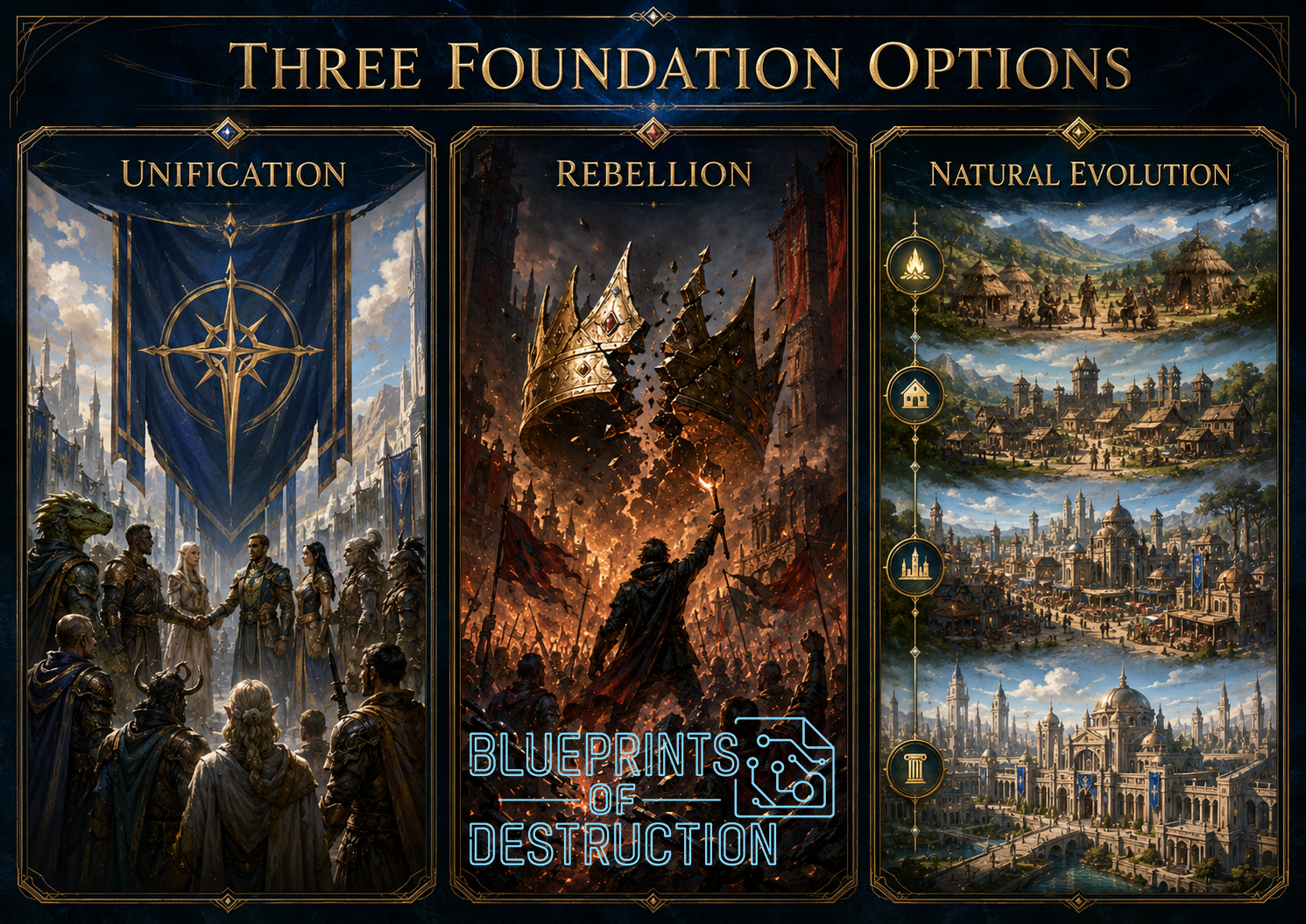
Three Simple Ways a Government Can Begin
1. Unification
This government forms because multiple separate groups were forced or persuaded to come together. Unification works particularly well in worlds with tribes, cities, species, clans, or factions that were once divided.
What forced different groups to unite?
An example might be:
- A natural disaster made survival alone impossible.
- Several cities joined together to avoid war.
- Trade required shared rules.
The result of unification might be a single government that values order, shared identity, and loyalty.
2. Rebellion
In rebellion, a government forms because the people overthrew an old system. This works well if the world has a history of revolution, civil war, or broken trust.
What were the people rebelling against?
Examples of this might be:
- A corrupt empire.
- A foreign occupier.
- A magical or technological elite.
The result of foundation through rebellion might value freedom, justice, revenge, or control disguised as reform.
3. Natural Evolution
A government formed through natural evolution develops gradually because society becomes too complex to function without one. This works well in worlds that feel old, layered, and deeply rooted in tradition.
What became too complicated for people to manage casually?
Examples might be:
- Trade that required currency and contracts.
- Cities that needed roads, water, and defense.
- Families became clans, clans became towns, and towns became nations.
A government established through natural evolution may feel traditional, bureaucratic, and slow.
The creation of a governmental foundation in simple terms might be:
A problem needs a response. A response results in authority. Authority becomes tradition.
Founding Principle Worksheet
1. What major problem existed before the government was formed?
This might be war, disaster, hunger, fear, invasion, trade, rebellion, or survival.
2. Who suffered from the problem?
Was it common people, nobles, workers, soldiers, merchants, families, or even entire species?
3. Who offered the solution?
The solution could have come from a king, a council, an army, a family, a hero, or an outside force.
4. What did the people give up in exchange for safety and order?
Did the people lose freedom, land, privacy, wealth, or independence?
5. How does the government explain its own beginning?
Does the government say it is a protector, a liberator, a chosen authority, a sacred order, or a necessary evil?
6. Is there a hidden truth?
Was the founding truly noble? Was it selfish, accidental, forced, manipulated, or misunderstood?
The founding principle gives your world's government its soul. It explains why the system exists, what it values, what it fears, and what lies it needs to protect.
A government's founding story does not have to match the truth. Perhaps the people believe the government was created to protect them, while the hidden reality is that it only exists to control them, as is the case within Qualx, in the Blueprints of Destruction. The citizens may believe that the government brought peace, when the truth is that they erased everyone who disagreed.
Perhaps the citizens believe that their society evolved through natural progression of civilization, when the entire system was actually shaped by a single powerful figure behind the scenes.
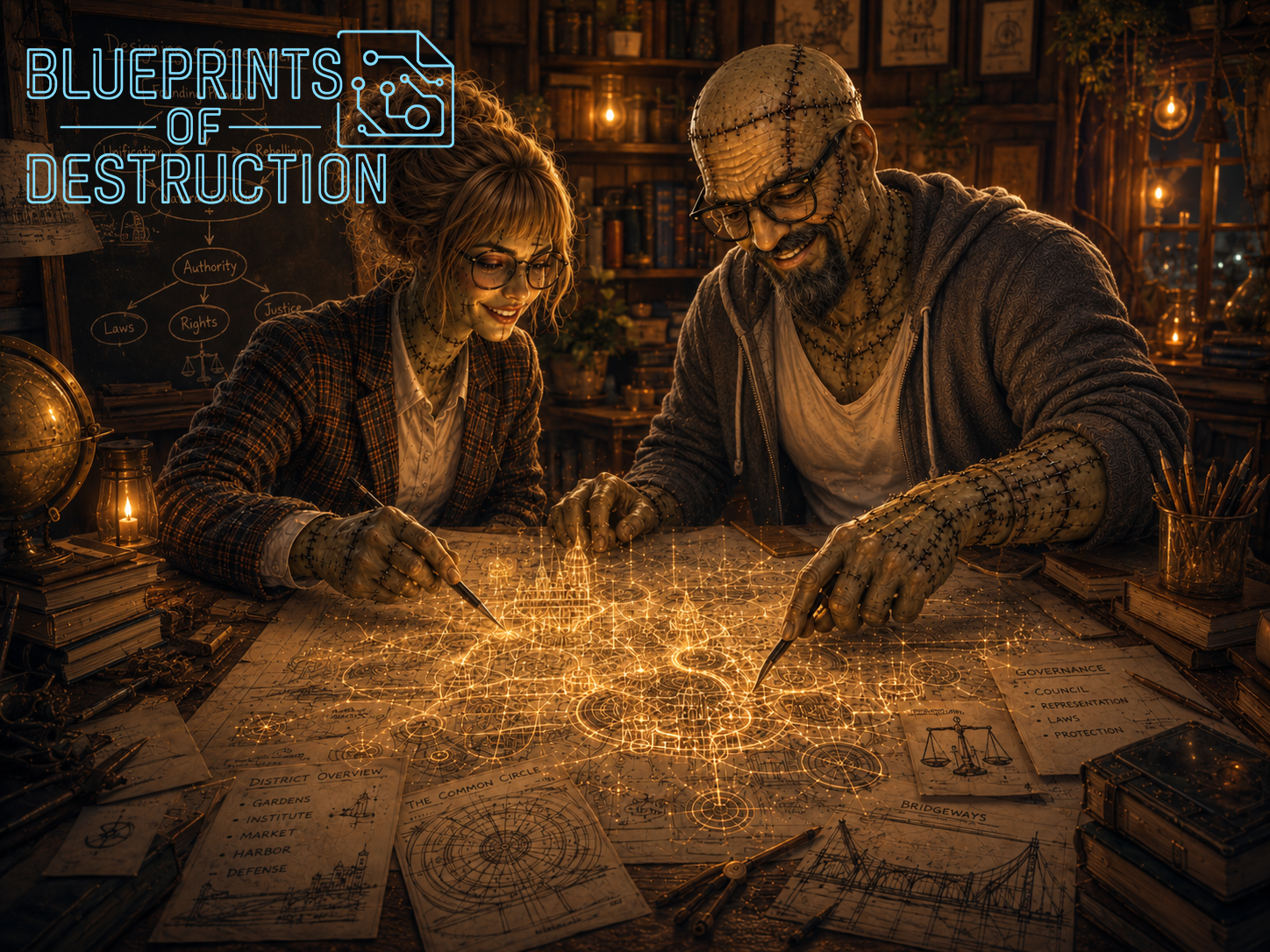
A government is never just a building, a throne, a council, or a title. Every government has a beginning. That beginning matters because it shapes everything that comes after it. A government born from fear will never feel like one born through hope. A government forged after rebellion will not behave the same as one built on time-tested traditions.
When you know why a system began, it is easier to understand why people obey it, trust it, fear it, or fight against it.
Before you name your rulers or design the first law of your world, examine the foundation and ask: What problem was this government made to solve?
Take that answer, and turn it into words on the page! Forge your world through the events that made it the civilization you see in your mind, and shape it so that other people can catch the same sense of wonder your story holds for you.
And you never know, you might stumble onto your very own world's blueprints. Perhaps they may even lead to destruction.
Download the Founding Principle Worksheet
Explore both sides of a fictional government's foundation: the public story that gives it legitimacy and the hidden strucutre that keeps it in power.
This six-page worksheet includes guided questions about founders, sacrifices, public beliefs, hidden truths, beneficiaries, contradictions, legitimacy, and story pressure.
Download the Free Fillable PDF
The worksheet will open in a new tab. Save a copy to your device before entering your answers, or print it and fill it out manually.
